Your BD Director Shouldn’t Have to Build the Whole Department
AEC firms with an internal business development professional can still need additional capacity. BD-AEC can work alongside an existing team for a pursuit, an event, a market initiative, or a defined period of pipeline development.
 By Scott Mann, Founder + Lead Business Development Director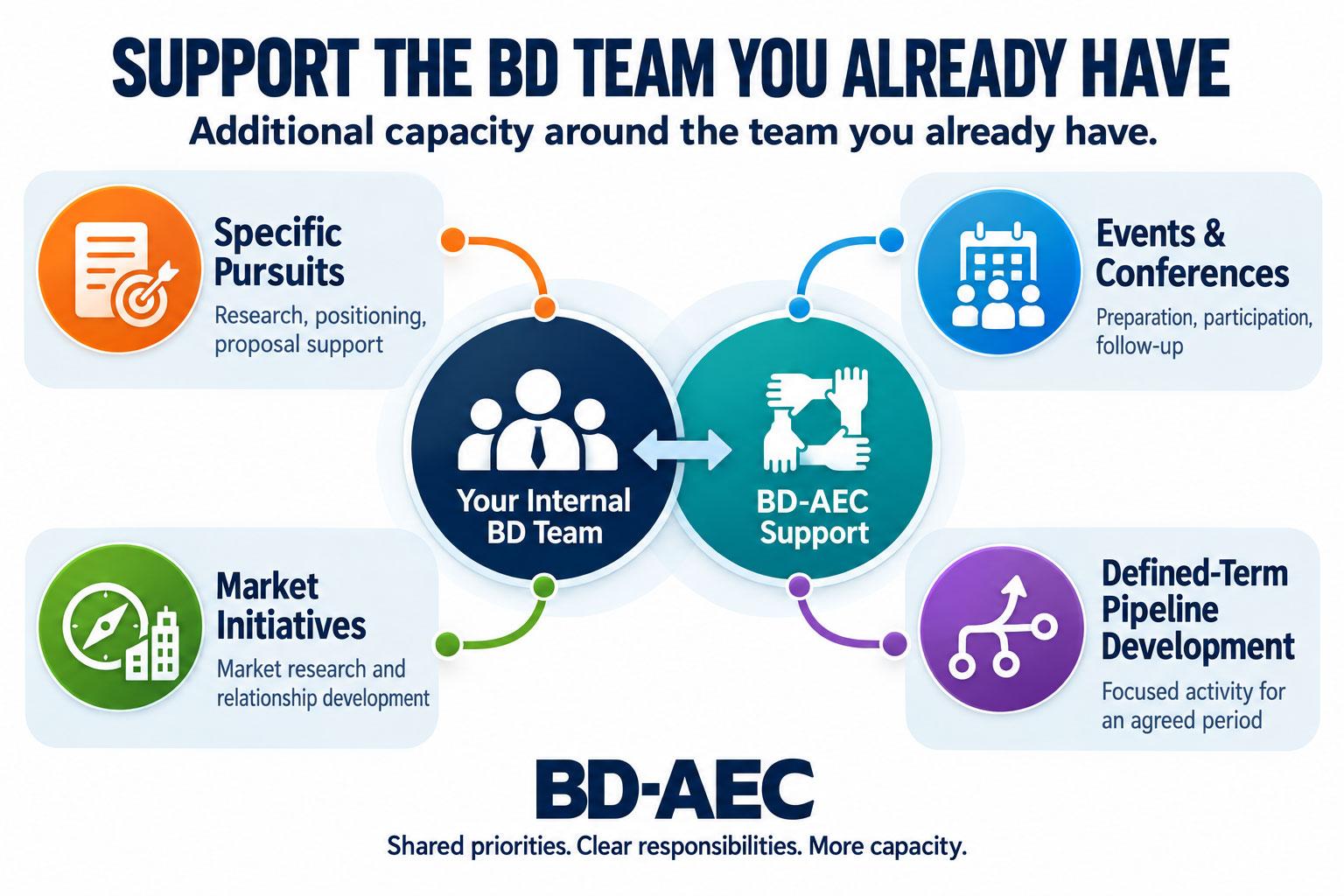
In this story 8 sections
In the past week, I spoke with a couple of firms that already have a business development professional. Those conversations raised a useful question: Where does BD-AEC fit when someone inside the company already owns business development?
It fits alongside them. An internal BD professional may provide strong leadership, understand the firm, and maintain valuable relationships while still needing help moving the work forward. Having someone responsible for business development doesn’t necessarily mean the organization has enough capacity to execute everything it wants to accomplish.
That distinction matters because getting a commitment for additional resources can be difficult. Leadership may recognize the need for help without being ready to add another salary, benefits package, and ongoing responsibility for recruiting, managing, and retaining an employee. Meanwhile, the work that prompted the conversation still needs to happen.
BD-AEC gives firms another way to address that need. We can embed alongside an existing business development team for a specific project, events and conferences, or a defined period of pipeline development.
The engagement can be built around the work the firm needs done.
One BD Professional Can Have a Department’s Worth of Responsibilities
Consider what an internal business development professional may be expected to manage. They need to understand the market, develop relationships, identify opportunities, maintain pipeline information, prepare for meetings, coordinate follow-up, support proposals, attend events, and keep leadership informed. They may also be involved in positioning, marketing materials, website content, and decisions about which markets the firm should pursue.
Those responsibilities connect, but they require different kinds of work. A client meeting needs preparation. A conference needs planning. A promising conversation needs follow-up. A new market needs research. A proposal needs information from technical staff and a clear argument about why the team is relevant to the client.
The BD professional may know exactly what should happen next. The problem can be finding enough time and support to make it happen consistently.
For example, a firm may want its BD Director developing relationships in a new market while also coordinating a major pursuit and preparing for an upcoming conference. Each initiative could be worthwhile, but assigning all three to the same person creates competing priorities. Leadership needs to decide what that person should own and where additional support would improve execution.
Additional capacity allows the BD professional to spend more time where their knowledge, relationships, and judgment are most valuable.
The Need for Help Doesn’t Always Justify Another Full-Time Position
Expanding an internal department can be the right decision. If a firm has a sustained need for another professional and the resources to support the role, hiring may make sense. But the need for additional capacity doesn’t always arrive in the shape of a full-time job.
A firm may need substantial help for several months while entering a market. It may have a pursuit that demands more attention than the existing team can provide. It may want to make better use of a conference without creating a permanent events position. Or leadership may want to build pipeline around a particular service before deciding how much ongoing BD capacity that service requires.
Those are real needs, even when they don’t justify another employee.
Hiring involves more than agreeing to a salary. The firm has to define the position, recruit, interview, onboard, provide benefits, manage performance, and work to retain the person. That commitment can be appropriate, but it can also be difficult to secure when leadership is still evaluating the scope or duration of the need.
An engagement with BD-AEC can be defined around an objective, a scope of work, and a period of time. The firm still needs to make an investment and participate in the work, but it has another option for adding capacity without creating a permanent position.
We Play Well With Others
An existing BD professional brings knowledge we should respect. They understand the firm’s history, leadership, relationships, internal dynamics, and priorities. They may have spent years earning trust with clients and colleagues. Our job is to understand that context and contribute effectively within it.
That starts with agreeing on responsibilities. What does the internal BD professional want to retain? Where would additional support make the greatest difference? Who manages which relationships? Who communicates with technical staff? How will information be shared, and who decides what happens next?
Those questions deserve clear answers at the beginning of an engagement. Otherwise, additional resources can create additional coordination without improving execution.
The internal BD professional should help shape the support. They’re often in the best position to identify where work is getting delayed, which opportunities need attention, and what would allow them to be more effective. We can build the engagement around those needs and establish a working rhythm that keeps everyone informed.
For me, “we play well with others” means respecting the people already doing the work, being clear about our role, and following through on the responsibilities we accept. The internal BD professional should experience our involvement as useful support for the department they’re helping lead.
Embed Around a Specific Project or Pursuit
A particular opportunity can create a temporary demand that exceeds the department’s normal capacity. The firm may need more research, help coordinating partners, stronger positioning, proposal support, or preparation for a shortlist interview.
BD-AEC can embed around that pursuit. The internal BD professional may continue to lead the client relationship while we help evaluate the opportunity, organize information, develop the pursuit strategy, and move agreed tasks toward completion.
The scope should reflect where support is needed. Some pursuits may call for involvement from initial evaluation through submission and interview preparation. Others may need focused help with one part of the process.
A defined engagement also gives the firm an opportunity to retain useful work after the deadline passes. Research, project descriptions, resumes, positioning language, and lessons from the pursuit can support future opportunities. The immediate objective is to compete effectively, but the effort should also leave the existing department better equipped for what comes next.
Make Events and Conferences Part of a Business Development Effort
Events and conferences can require more work than the time spent attending them. Someone needs to decide why the firm is going, identify relevant people and organizations, arrange conversations where possible, prepare the team, and coordinate follow-up afterward.
An internal BD professional may be capable of doing all of that while also managing the rest of the pipeline. The question is whether the calendar allows it.
BD-AEC can support a defined event or conference effort, with responsibilities agreed in advance. That could include researching attendees and organizations, identifying relationship priorities, preparing meeting information and materials, participating in agreed activities, and helping manage follow-up.
The objective should be specific enough to guide the effort. Is the firm trying to develop teaming relationships, meet owners in a target sector, understand a new market, or reconnect with existing contacts? The answer influences whom we seek out, what we prepare, and what happens after the event.
A conference becomes more useful when the conversations have a purpose and someone takes responsibility for carrying them forward. The value of participation depends partly on what the firm does before arriving and after returning to the office.
Build Pipeline for a Defined Period
A firm may want focused pipeline development for a specified duration. Perhaps leadership wants to explore a geography, develop opportunities around a service line, or create more consistent activity while the internal BD professional concentrates on key accounts.
A defined period of support can give that initiative attention. We can work with the firm to establish priorities, research the market, identify appropriate organizations and contacts, support outreach, coordinate follow-up, and document what we learn.
The engagement should begin with a shared understanding of what progress will look like. Depending on the objective, useful results may include better market knowledge, relevant relationships, qualified opportunities, or clearer evidence about whether the firm should continue investing in that direction. Project awards may take longer than the engagement itself, so expectations need to reflect the market and the buying process.
At the end of the period, leadership and the internal BD professional should have information they can use. What gained traction? What stalled? Which relationships deserve continued attention? What should the firm do next?
That gives the organization a basis for deciding whether to continue the support, adjust the effort, or bring more of the work in-house. It also makes the research, relationship history, and next actions available to the people responsible for continuing the effort.
Make the Commitment Specific
A general request for “more BD resources” can be difficult for leadership to evaluate. A defined request gives everyone something concrete to discuss: the work that needs to happen, why it matters, who will own it, how long support is needed, and what the investment will be.
That doesn’t guarantee approval, but it makes the decision easier to understand. Leadership can evaluate a specific pursuit, conference effort, or pipeline initiative against the firm’s priorities rather than trying to decide whether the department needs another permanent position.
A defined scope also creates accountability for the engagement. The firm and BD-AEC should know what we’re working toward, what participation we need from the internal team, and how progress will be reviewed. Additional capacity is useful when it has a clear purpose and fits into the department’s existing work.
An Existing BD Department Can Be a Good Starting Point
A firm that already has a business development professional may have clear direction, established relationships, and a strong understanding of where support is needed. Those are valuable foundations for an engagement.
The conversation can begin with a practical question: What could your BD professional accomplish with the right help around them? The answer might be a stronger pursuit, a better conference effort, a more deliberate entry into a market, or several months of consistent pipeline development.
BD-AEC can work alongside the people already responsible for your growth. The engagement can have a specific purpose and a defined duration, with responsibilities built around what would help the existing team most.
Having a BD professional can be the starting point for working with BD-AEC.
If your firm needs additional capacity for a project, an event, a conference, or a defined period of business development, let’s talk about what would help your team move the work forward.
About this story
Written byScott MannFounder + Lead Business Development Director, BD-AEC
- Issued
- October 14, 2026
- Corrections
- Spotted an error? Tell us.