Market Intelligence Is More Than Finding RFPs
Knowing what projects are available is useful. Knowing why they are happening, who is influencing them, what clients are thinking, and how to position your firm to pursue them is business intelligence.
 By Scott Mann, CEO | Strategic Partner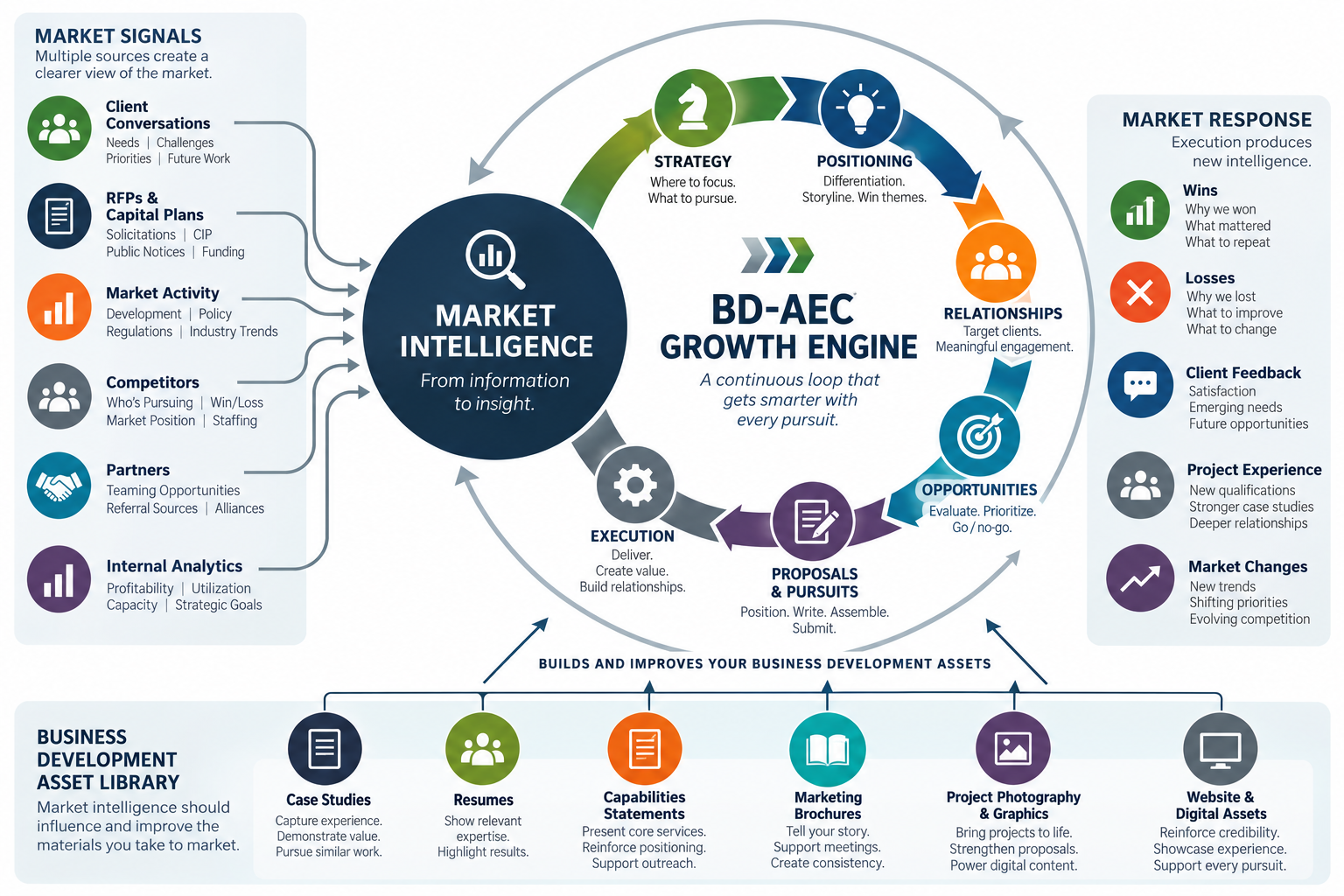
In this story 14 sections
For many small and mid-sized AEC firms, market intelligence begins with a list of projects. Someone checks an RFP database. An owner forwards a public notice. A project manager hears about something from a client. A Business Development Director reviews a capital improvement plan. A construction publication announces a new development. Someone sees a planning commission agenda and sends it around the office.
All of that information can be valuable. But I wouldn’t call most of it market intelligence.
I would call it project information.
Market intelligence begins when we start connecting those individual pieces of information and asking what they tell us about the market. There is an important difference.
A Project Is Information. A Pattern Is Intelligence.
Suppose we discover that a municipality is planning a new public works facility. That is information.
Now suppose we know the existing facility has been inadequate for years, funding has finally become available, the city has recently hired a new public works director, a particular architecture firm helped with preliminary planning, and several other municipalities in the region are facing similar facility problems.
That begins to look like intelligence.
The project matters, but so does everything around it. Why is the project happening now? Who has been involved? Where did the funding come from? What relationships already exist? What problems is the owner trying to solve? What firms are likely to pursue it? Is this an isolated project or evidence of something happening across the market?
Those questions move us beyond finding opportunities and toward understanding them.
An RFP Database Is a Tool, Not a Market Intelligence System
I have no problem with RFP databases. We use them.
For the kinds of AEC firms we work with, they can be an efficient way to discover opportunities that would otherwise be missed. As we discussed in an earlier article, I also disagree with the blanket assertion that finding a project when the RFP is released automatically means you’re too late. Plenty of good projects are won by firms that were not involved years before the solicitation.
The problem isn’t using an RFP database.
The problem is mistaking an RFP database for your entire business development intelligence system.
A database can tell us that a solicitation exists. It may tell us the estimated construction value, due date, scope, location, owner, procurement method, or pre-bid meeting date.
It usually cannot tell us everything we really want to know. Why this project? Why now? Who cares about it? Who already knows about it? Who is likely to pursue it? Who might need a partner? How does the owner perceive our firm? What happened on the owner’s last three similar procurements? Is this client likely to have more work? Does this opportunity fit where our firm is trying to go?
Those answers require a broader view of the market.
Some of the Best Intelligence Doesn’t Look Like Business Development
A project manager hears that a client’s capital budget may be tightening next year. An engineer learns during a project meeting that the client is frustrated with another consultant. A principal hears that a respected public works director is moving to another municipality. Someone at an industry event mentions that a developer is struggling to get a project entitled. A contractor says it is seeing significantly more work in a particular market. A client asks whether your firm has ever considered adding a service you currently subcontract.
None of those conversations may produce an immediate opportunity. Every one of them could matter.
This is one reason business development cannot be reduced to lead generation. The market is constantly producing signals. The challenge is recognizing which signals matter, connecting them to other information, and getting them to the people who can act on them.
A firm can have dozens of employees talking to clients every week and still possess surprisingly little organized market intelligence. The information exists. It just isn’t moving.
Your Technical Staff May Know More About the Market Than Your CRM Does
This is particularly true in AEC because so much client interaction happens through technical professionals. Your engineers, architects, construction managers, inspectors, surveyors, and project managers may spend far more time with clients than anyone formally responsible for business development.
They hear things. A client mentions an upcoming project. A consultant is retiring. A competitor is struggling with staffing. A funding source is becoming more important. A project is being delayed. A developer is entering a new geography. An agency is unhappy with its current process.
Most of that information will never appear in a formal market report. Some of it won’t even make it into the CRM.
That doesn’t mean every casual comment needs to become a database entry. Turning every employee into a data-entry clerk would probably make the problem worse. The objective is to create an organization in which useful market information has somewhere to go.
A technical professional should know whom to tell when something sounds important. Business development should know how to ask good questions. Leadership should have a way to see emerging patterns rather than isolated anecdotes.
That is less about software than behavior.
Business Development Should Be Listening While It Is Selling
There is another reason I think execution and market intelligence belong together. If every business development conversation is treated primarily as an opportunity to tell someone about the firm, we waste half the value of the conversation.
We should be listening.
What are clients worried about? What are they spending money on? Where are they having difficulty finding consultants? What services are becoming commoditized? Where are schedules becoming more important? What types of projects are being delayed? Which procurement methods are becoming more common? What are owners saying about our competitors? What do they say about us?
The best business development professionals aren’t simply carrying information into the market. They are bringing information back.
Every conversation has two potential outputs: relationship momentum and market intelligence.
Sometimes the intelligence may ultimately be more valuable than the immediate opportunity.
Intelligence Should Change the Story We Tell
This is where market intelligence begins to connect directly with marketing and creative assets.
If we repeatedly hear that clients are struggling with a particular problem, that should influence how we describe our services. If buyers consistently respond to one aspect of our experience, that should influence our positioning. If a certain project becomes an important credential for pursuing similar work, we should capture that project as a case study while the information is still accessible.
Market intelligence should eventually become visible in the materials the firm takes back into the market.
That means the website should evolve. Capabilities statements should evolve. Marketing brochures should evolve. Project descriptions should improve. Case studies should reflect the work the firm wants more of. Resumes should demonstrate the experience most relevant to the opportunities being pursued.
This connects directly to the idea from our previous article: execution creates intelligence.
But intelligence only becomes valuable when we use it.
Proposal Writing Shouldn’t Begin When the RFP Arrives
This is especially important when an opportunity becomes a formal pursuit.
Too many AEC firms effectively begin writing the proposal when the RFP hits the street. That starts a familiar scramble. Someone needs the project manager’s resume. Nobody knows where the latest version is. A similar project was completed two years ago, but there isn’t a usable case study. Someone needs photographs. The project description was written for a completely different market. The capabilities statement is outdated. The website doesn’t reflect a service the firm has been providing for three years.
Meanwhile, the submission deadline is approaching.
That isn’t really a proposal-writing problem.
It’s an infrastructure problem.
A firm that pursues work consistently should be building the raw materials for future pursuits continuously. That includes a strong library of staff resumes, project descriptions, case studies, project photography, references, statistics, client outcomes, certifications, capabilities statements, brochures, teaming information, and other reusable qualifications.
Digital assets matter too. A selection committee or prospective teaming partner may visit the firm’s website while evaluating a proposal. Someone receiving an introductory email may search the firm before responding. The proposal, capabilities statement, website, LinkedIn presence, and other digital materials shouldn’t tell five different versions of the company’s story.
They should reinforce one another.
A Case Study Library Is a Business Development Asset
I think case studies deserve particular attention.
A completed project isn’t only revenue that has already been earned. It can become a qualification for the next project.
But only if the firm captures it.
What was the client’s problem? What was the scope? Who performed the work? What made the project difficult? What did the team actually do? What was the outcome? What photographs tell the story? What statistics matter? What services were involved? Which staff members should receive credit for the experience?
If that information is captured while the project is fresh, it becomes reusable business development infrastructure. It can support a proposal, capabilities statement, website project page, presentation, social post, interview, introductory email, or conversation with a prospective client.
If it isn’t captured, someone may have to reconstruct the story years later while a proposal deadline is approaching.
The same principle applies to resumes. An AEC resume shouldn’t simply document someone’s employment history. It should make it easy to demonstrate why that individual is relevant to a particular pursuit.
Good collateral makes the firm’s accumulated experience accessible.
Proposal Writing Is an Exercise in Positioning
Once the underlying library exists, proposal development becomes a much better exercise.
The question is no longer, “What information can we find before Friday?”
It becomes, “Which parts of our experience matter most to this client?”
That is a fundamentally different question.
A strong proposal isn’t simply a repository of qualifications. It is a positioning document. The firm is selecting from everything it knows about itself and presenting the combination of people, projects, experience, approach, and story that is most relevant to a particular buyer and opportunity.
This is where market intelligence becomes especially valuable. What do we know about the client? What appears to matter in the selection criteria? What have we learned from previous pursuits? Who are the likely competitors? Where are we strongest? Where might the client perceive risk? Which projects establish credibility? Which team members reinforce the story? What differentiators can we actually substantiate?
The proposal should reflect those answers.
This Is Why Proposal Support Is Part of BD-AEC
At BD-AEC, we see proposal and SOQ development as part of the business development process, not a separate administrative task that begins when a solicitation appears.
Our role can include evaluating the opportunity, developing the pursuit strategy, establishing win themes, organizing the response, writing and editing content, coordinating team information, and helping assemble the qualifications that support the argument being made.
But the work extends beyond individual proposals.
We also help build the infrastructure that makes future pursuits stronger and more efficient: case study libraries, staff resumes, capabilities statements, marketing brochures, project narratives, positioning language, website content, and other digital assets.
Those materials are valuable because they allow what the firm learns in one pursuit, project, or client conversation to improve the next one.
A case study created for one proposal can become website content. A project description developed for the website can become the starting point for an SOQ. A refined resume can support multiple pursuits. A strong capabilities statement can support direct outreach and teaming conversations. Market feedback can change the positioning used across all of them.
The assets start working together.
Market Intelligence Also Comes From Losing
AEC firms understandably spend more time celebrating wins than studying losses. But a lost pursuit can produce tremendous intelligence if we are willing to investigate it.
Who won? Why? Was our team credible? Was our positioning wrong? Did the client already have a relationship? Did we misunderstand what mattered most? Was our project experience weaker than we thought? Was price a factor? Was the opportunity poorly qualified from the beginning? Would a different partner have changed the outcome? Should we pursue the next one?
A loss that teaches us nothing is simply a loss.
A loss that changes the way we approach the next opportunity has produced something of value.
The same is true of wins. Winning doesn’t necessarily mean every assumption was correct. Understanding why we won can help us recognize what the market actually values about the firm.
This is why I believe every pursuit should make the next pursuit better.
Internal Intelligence Matters Too
Market intelligence isn’t only about what is happening outside the firm. In our discussion of pipeline, we looked at the importance of understanding profitability, utilization, capacity, employee interests, strategic objectives, and the kinds of work the organization actually wants.
That information has to meet the external market intelligence somewhere.
The market may tell us there is enormous demand for a particular service. That doesn’t automatically mean we should pursue it. Perhaps we lack capacity. Perhaps the margins are poor. Perhaps the work doesn’t fit our long-term direction. Perhaps we don’t have the qualifications to compete effectively.
The reverse can also happen. Internal financial data may show that a certain type of project is exceptionally profitable, but the market may be telling us demand is weakening or competitors are flooding into the space.
Market intelligence tells us what the market may want to buy. Internal intelligence helps us decide what we should want to sell.
Business development becomes much more powerful when those two sets of information come together.
The Goal Isn’t More Data
It is easy to respond to all of this by building more dashboards. I don’t think that’s necessarily the answer.
AEC firms already have plenty of information. They have CRM records, accounting systems, project management software, RFP databases, email, meeting notes, client conversations, industry publications, capital plans, planning agendas, conference conversations, proposal debriefs, websites, project histories, and the collective knowledge of their employees.
The problem is rarely a complete absence of data.
The problem is determining what matters and turning it into action.
Good market intelligence should influence where the firm spends business development time, which relationships deserve attention, what services it promotes, what markets it enters, which opportunities it pursues, how it positions itself, which case studies it develops, what its website says, and where it chooses not to compete.
If the intelligence doesn’t change a decision or improve an action, it may simply be information.
This Is Where the Growth Engine Becomes a Loop
Market intelligence sits at the beginning of the BD-AEC Growth Engine, but it is also produced by everything that follows it.
We use intelligence to help shape growth strategy. Strategy influences positioning and storyline. Positioning helps determine the relationships and pursuits we activate. Our collateral gives that positioning tangible form. Proposal development applies it to specific opportunities. Execution takes all of it into the market.
Then the market responds.
That response produces new intelligence.
The process isn’t linear. It loops.
A meeting changes our understanding of the client. A pursuit changes our understanding of the competition. A proposal debrief changes our positioning. A completed project becomes a new case study. A new case study strengthens the next proposal. A client conversation exposes another market. A loss changes our go/no-go criteria. A win teaches us something about what the market values.
Every pass through the market should make the organization a little smarter and its business development assets a little stronger.
Market Intelligence Is a Competitive Habit
Small and mid-sized AEC firms don’t need a corporate research department to do this well. They need curiosity. They need people who ask questions. They need technical professionals who recognize when something they hear might matter beyond the project in front of them. They need business development professionals who listen as much as they talk. They need proposal writers who understand positioning rather than simply assembling information. And they need leadership willing to reconsider assumptions when the market says something different.
They also need the infrastructure to retain what the organization learns.
The goal isn’t to know everything happening in the market. That’s impossible. The goal is to become progressively better at recognizing the information that matters to your firm, capturing the experience that proves what you can do, and putting both to work in the next opportunity.
Which clients are changing? Which relationships are developing? Which markets are moving? Which competitors keep appearing? Which project types are producing attractive economics? Where are we gaining traction? Where are we repeatedly failing? What are clients asking for? Which case studies demonstrate the work we want more of? Are our resumes telling the right story? Does our website support our positioning? Are our proposals getting stronger?
Those questions are far more valuable than another hundred names added to a prospect list.
An RFP tells you there is a project.
Market intelligence helps you understand what to do about it.
And good business development infrastructure helps you do something about it when the opportunity arrives.
About this story
Written byScott MannCEO | Strategic Partner, BD-AEC
- Issued
- September 28, 2026
- Corrections
- Spotted an error? Tell us.