Build Your BD Department—or Embed One?
AEC firms need business development capacity. The real question is whether to build that capability internally or plug into a team already doing the work.
 By Scott Mann, CEO | Strategic Partner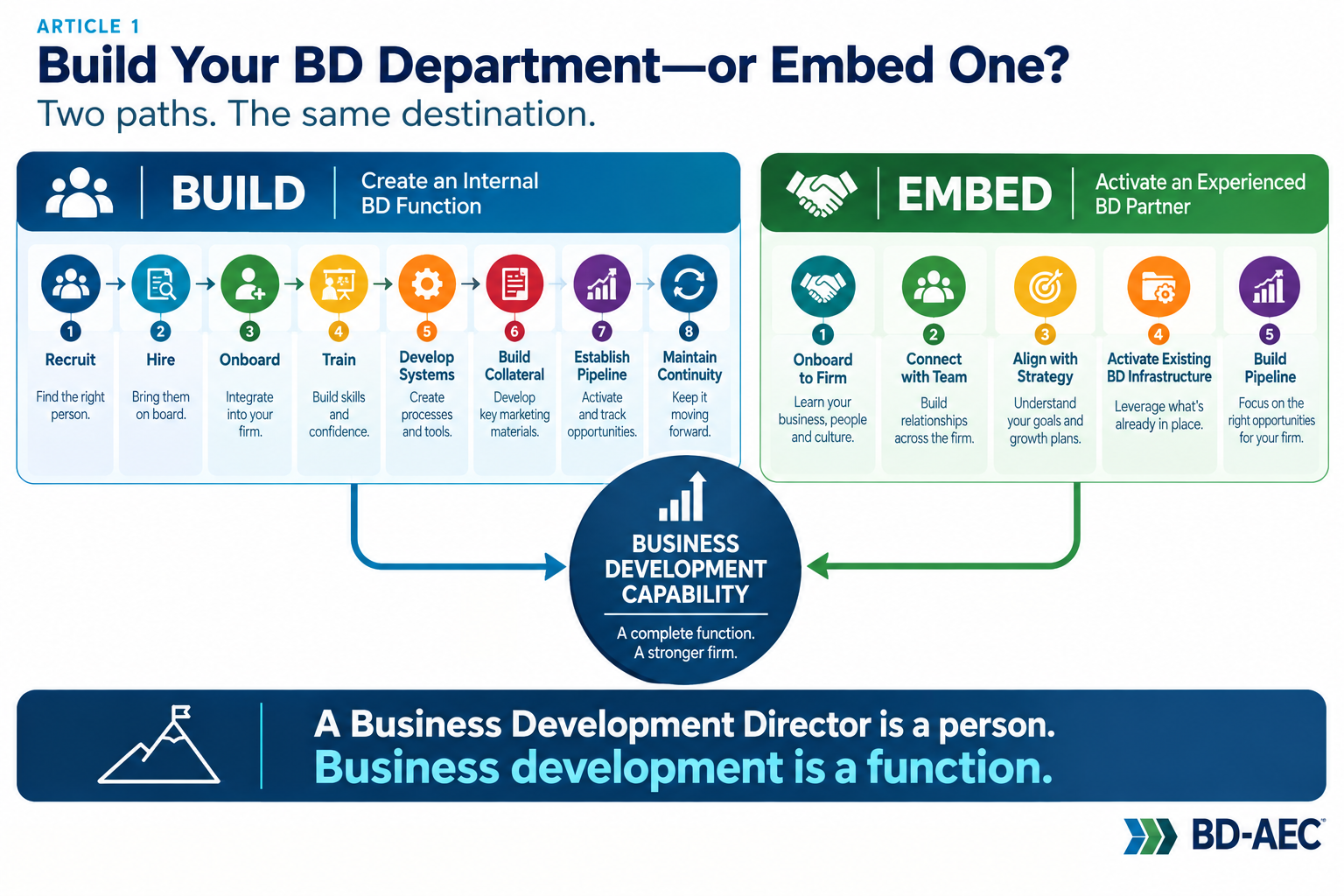
In this story 11 sections
There comes a point in the growth of many architecture, engineering, and construction firms when business development can no longer be something the principals simply fit into their schedules.
The firm has grown. Project delivery demands more attention. The opportunity pipeline needs to be more intentional. Relationships need consistent attention. Someone needs to look beyond today's backlog and think about where the next projects will come from.
The conventional response is often:
“We need to hire a Business Development Director.”
Maybe.
But I think there's a more important question to answer first:
Do you want to build a business development department, or do you want to access one that's already operating?
Those aren't the same decision.
A Business Development Director Is a Person. Business Development Is a Function.
Hiring an experienced Business Development Director can be an excellent decision for an AEC firm.
But hiring one person doesn't create a business development function.
Someone still needs to research markets and accounts. Opportunities have to be identified and evaluated. Contacts need to be researched. Meetings need to be prepared. CRM information needs to be maintained. Follow-up needs to happen. Marketing materials need to support the conversations taking place in the market. Proposals and SOQs need pursuit strategy and positioning. Leadership needs useful information about what's happening outside the company.
Some firms already have much of that infrastructure.
Many don't.
So when an AEC firm decides to hire its first Business Development Director or expand an existing BD team, it isn't simply adding another employee.
It's beginning to build a department.
And building a department takes considerably more than posting a job description.
Consider What Happens Before the New BD Director Makes the First Call
First, you have to find the right person.
That means defining the position, recruiting candidates, reviewing resumes, interviewing, negotiating compensation, checking references, and ultimately convincing someone you want that your firm is where they should spend the next stage of their career.
Then the real onboarding begins.
Your new BD professional has to learn your firm.
What exactly do you do?
Which services are most profitable?
Which projects best demonstrate your capabilities?
Which markets matter?
Where do you want to grow?
Which clients are most important?
Which relationships are strong?
Which relationships need work?
Who inside the company needs to participate in business development?
How does your firm pursue work?
What makes you meaningfully different from the dozen other qualified firms your prospective clients already know?
Your technical and executive staff have to participate in that education. Those are people who already have full calendars and responsibilities of their own.
Eventually, you reach another important threshold.
You begin introducing your new Business Development Director to the relationships you've spent years developing.
That's an act of trust.
You're effectively telling an important client:
This person represents us.
And then sometimes that person leaves.
What Happens When You Have to Make the Introduction Again?
Maybe your BD Director gets a better offer.
Maybe the position wasn't what they expected.
Maybe you discover they're excellent at networking but poor at creating measurable business activity.
Maybe the chemistry isn't right.
Maybe they simply don't produce.
Whatever the reason, you're back in the market.
Recruit.
Interview.
Hire.
Onboard.
Train.
Transfer knowledge.
Then return to that important client:
“I'd like you to meet our new Business Development Director.”
Once is normal.
But what happens when you've made that introduction several times?
AEC is a relationship business. We tell our clients that continuity matters. We talk about trusted advisers, long-term relationships, institutional knowledge, and being there for the life of a project.
Our clients notice when the people representing our firms continually change.
And they don't necessarily know why.
They don't know that someone received an offer you couldn't reasonably match. They don't know that another person simply wasn't right for the role. They don't know the circumstances surrounding a departure.
They see the pattern.
Eventually, the question may stop being:
“What happened to the last BD person?”
and become:
“What's happening at this company?”
That may be an entirely unfair conclusion.
But perception doesn't wait for all the facts.
Employee turnover can become a brand issue when the employees turning over are the people you've deliberately made the face of your company.
There's Another Problem We Don't Talk About Enough
I've spent a significant amount of time around business development professionals working inside AEC firms.
One complaint comes up repeatedly.
They can feel like they're on an island.
Think about the environment.
An engineer spends the day designing, calculating, solving technical problems, reviewing plans, and delivering work.
An architect is designing, coordinating, meeting deadlines, responding to clients, and managing projects.
A project manager may be juggling budgets, schedules, staff, subconsultants, and client expectations.
Then they look across the office at the Business Development Director.
The BD person made some phone calls this morning.
Then they went to lunch.
They're going to an industry event this afternoon.
Tomorrow they may be playing golf with a prospective client.
And sometimes the reaction is predictable:
That's work?
The BD person can be perceived as getting paid very well to have lunch, attend events, make calls, and talk to people while everyone else is doing the “real work.”
But those conversations are the work.
The lunch isn't valuable because someone got a good meal.
It's valuable if we learn that a client is planning an expansion eighteen months before the project hits the street.
The association meeting isn't valuable because we attended another event.
It's valuable if we're developing relationships with the people who will influence the firm's next opportunity.
The phone call isn't chit-chat if it moves a relationship forward.
Business development work simply doesn't look like project-delivery work.
And that difference can create friction inside technically oriented organizations.
The Environment Can Change the BD Professional, Too
The problem isn't only that technical staff may misunderstand business development.
The organization can gradually change the behavior of the BD professional.
When you're the only person—or one of very few people—focused primarily on growth, it's easy to get pulled inward.
Another internal meeting gets added to the calendar.
Then another responsibility.
There's a committee that needs help.
Someone asks you to handle something because you “have a little flexibility.”
Office politics consume attention.
Company gossip becomes interesting.
Internal activity starts filling time that was supposed to be spent looking outward.
Eventually, there's a risk that the person hired to think entrepreneurially about the market begins thinking primarily like an employee inside the organization.
There are outstanding internal Business Development Directors, and strong firms can create environments where they thrive.
But I think AEC leaders should recognize the challenge:
You're asking a person whose job is to look outward to spend every day inside an organization overwhelmingly focused inward on delivering today's work.
That environment matters.
Business Development People Need Other Business Development People
We accept this idea almost everywhere else.
Engineers benefit from working around talented engineers.
Young architects develop faster when they're surrounded by experienced architects.
Project managers learn from other project managers.
People compare approaches. Ask questions. Challenge one another. Share what works. Develop standards. Mentor younger professionals. And, yes, compete with each other.
Why should business development be different?
A BD professional surrounded by other BD professionals hears different conversations.
Who are you calling?
What did you learn?
How did that meeting go?
Who else should we know?
Why aren't they responding?
What's happening in that market?
Is that opportunity real?
Who is the decision-maker?
What did we miss?
What's the next move?
Someone lands a meeting everyone wanted.
Someone uncovers an opportunity before it becomes public.
Someone finds an introduction into an account that's been difficult to penetrate.
Someone develops an approach that works.
Other BD professionals see it.
They learn from it.
And competitive people want to produce.
Culture affects performance. Business development has a culture, too.
That's the Case for an Embedded BD Department
Outsourcing business development is sometimes described as hiring a fractional Business Development Director.
That description isn't wrong, but I think it's incomplete.
The more interesting model is an embedded business development department.
Instead of recruiting one person and then trying to assemble the capabilities that person needs, an AEC firm can plug into an existing business development operation.
The distinction matters.
With BD-AEC, we're not learning how to do business development while a client pays us to figure it out.
We're already doing it.
Our team is engaged in business development across multiple AEC firms. We're researching markets, identifying opportunities, developing relationships, preparing for meetings, supporting pursuits, refining positioning, working with creative resources, managing pipeline information, and following opportunities into the market.
Our people work alongside other people doing the same thing.
There is mentoring.
There is accountability.
There is shared intelligence.
There is competitive energy.
And there is continuity.
We work inside your firm without becoming isolated inside it.
Outsourcing Doesn't Eliminate Onboarding
It's important to be precise about this.
An outsourced BD department still needs to learn the client.
We need to understand your people, capabilities, history, projects, clients, relationships, markets, competitors, culture, objectives, and ambitions.
There is no shortcut around that.
But there is a significant difference between teaching an experienced BD organization about your company and building a business development organization around a new employee.
We don't need the client to create our business development processes.
We don't need to learn how to research a market, prepare for a meeting, manage a pipeline, develop an account, or follow an opportunity.
The business-development infrastructure already exists.
The onboarding is about integrating that infrastructure with the client.
That's what we mean by embedded.
What About Continuity?
No organization can promise that individual people will never change.
That's not the point.
The point is whether the business development function itself depends entirely on one individual.
When one employee owns most of the relationships, market knowledge, conversations, pursuit history, and context surrounding the pipeline, that employee becomes a point of organizational vulnerability.
A department operates differently.
Knowledge can be shared.
Activity can be documented.
Multiple people understand the strategy.
Relationships have context.
Processes continue.
The firm isn't forced to recreate the function every time one person changes.
Your relationship with the market shouldn't depend entirely on the employment status of one person.
Should Every AEC Firm Outsource Business Development?
No.
Some firms should absolutely build internal BD departments.
If an organization has the scale, resources, leadership capacity, and long-term need to recruit and support a complete internal business development organization, owning that capability can make tremendous sense.
But firms should make that decision understanding what they're actually choosing.
The comparison isn't:
Employee vs. consultant.
And it isn't:
Full-time vs. fractional.
It's:
Build the department—or access the department.
If you build it, build it intentionally.
Give your BD professionals the tools, resources, support, culture, career development, and internal respect necessary to succeed.
If you don't want to build all of that—or don't need enough capacity to justify it—then consider embedding a team that's already operating.
A Different Way to Think About Fractional Business Development
For us, fractional business development isn't about taking a full-time job and selling pieces of someone's calendar.
It's about giving an AEC firm access to the amount of business development infrastructure it needs at its current stage of growth.
Senior BD leadership.
Market intelligence.
Strategy.
Creative capacity.
Relationship development.
Pursuit support.
Pipeline management.
Execution.
And the people and systems that connect them.
As the need changes, the level of support can change with it.
That's why I believe the better question isn't:
“Do we need to hire a Business Development Director?”
It's:
“What business development capability does our firm need—and do we really need to build all of it ourselves?”
About this story
Written byScott MannCEO | Strategic Partner, BD-AEC
- Issued
- September 28, 2026
- Corrections
- Spotted an error? Tell us.