Small AEC Firms Don’t Need a Scaled-Down Version of Big-Firm Business Development
A $5 million engineering or architecture firm shouldn’t build its growth strategy by copying a $500 million company. The economics, resources, opportunities, and people are different.
 By Scott Mann, CEO | Strategic Partner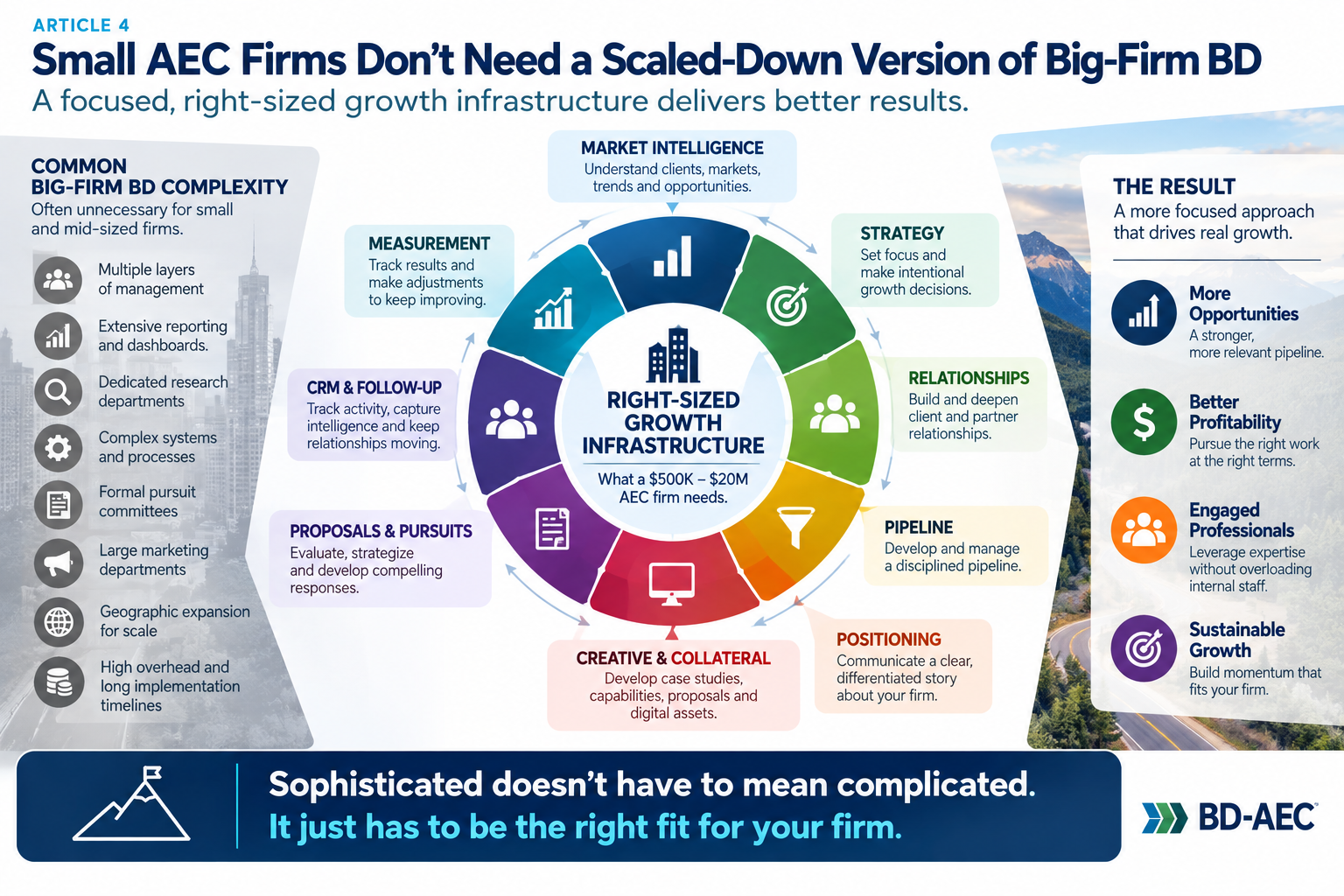
In this story 11 sections
Spend enough time around AEC business development and you’ll hear a lot of good advice: develop key-account plans, get upstream of opportunities years before procurement, build relationships with every important stakeholder, maintain detailed capture plans, create dedicated marketing and proposal teams, assign account managers, track dozens of metrics, build elaborate CRM workflows, and segment markets, clients, geographies, and service lines.
None of those ideas are inherently wrong. The problem is that much of the business development advice circulating through the AEC industry reflects the resources and organizational structure of very large firms. That’s not the market most smaller AEC firms live in.
A $3 million engineering company doesn’t need the business development department of a $300 million engineering company reduced to one percent of its original size. It needs a different model.
Smaller AEC Firms Aren’t Just Smaller Big Firms
BD-AEC primarily works with architecture, engineering, construction, and specialty firms with approximately $500,000 to $20 million in annual revenue. That’s a broad range, but these firms often have something important in common: their most valuable people wear multiple hats.
The owner may also be the senior engineer. The president may still manage projects. The principal architect may be reviewing drawings this afternoon and meeting a prospective client tomorrow morning. The person writing the proposal may also be managing the project if the firm wins it. The firm’s technical leaders aren’t sitting several layers above project delivery. They’re in it.
That changes business development. At a large firm, a dedicated capture team might spend months developing a pursuit. At a smaller firm, that same approach may require pulling the firm’s most productive people away from the projects generating today’s revenue. That isn’t a minor difference. It’s a different economic reality.
The Goal Isn’t to Look Like a Bigger Firm
Growth creates a temptation. A smaller firm looks at a successful national competitor and sees dedicated Business Development Directors, marketing coordinators, proposal specialists, CRM administrators, market researchers, graphic designers, communications staff, and capture managers. It can be tempting to begin recreating that structure: hire a marketing person, add a Business Development Director, buy more software, create more meetings, and introduce more processes.
Eventually, the company can find itself adding overhead faster than it adds productive growth capacity. That’s particularly dangerous in a professional-services business. The objective of business development isn’t to build an impressive business development organization. It’s to create profitable work.
Every piece of growth infrastructure should ultimately serve that objective.
Smaller Firms Have an Advantage Large Firms Would Love to Have
Smaller AEC firms shouldn’t think of their size only as a limitation. They have advantages that can be extremely valuable in business development.
The person making the business development call may be one phone call away from the company president. A prospective client can meet the person who will actually manage the project before a proposal is ever submitted. Decisions can happen quickly. A new market doesn’t necessarily require approval from multiple corporate layers. A good opportunity can be discussed in the morning and pursued that afternoon. The firm’s story can change as the market changes.
A 12-person engineering company doesn’t need to pretend it’s a 1,200-person engineering company. It needs to become exceptionally good at being a 12-person engineering company. Business development should reinforce that advantage rather than bury it beneath big-company processes.
You Don’t Need to Know About Every Project Three Years in Advance
Getting upstream of an opportunity is valuable. If you can develop a relationship with a public agency, understand its Capital Improvement Plan, recognize a future need, and participate in conversations before the project is formally defined, that’s excellent business development. Do it.
But smaller firms shouldn’t conclude that every project they discover at the RFQ or RFP stage is automatically a lost cause. In the markets where I work, I routinely see projects under roughly $5 million awarded to firms that had nothing to do with creating the project and may not have known it existed until the solicitation was released.
That’s normal. The important question for the smaller firm isn’t whether it achieved the theoretically perfect position on every opportunity. It’s whether it can recognize a good opportunity, learn quickly, mobilize the right people, develop a compelling position, and make a disciplined decision about whether to pursue.
Being early is valuable. Being effective matters more.
You Probably Don’t Need Hundreds of Prospects
Another place where smaller firms can get distracted is pipeline volume. More isn’t automatically better. A 10-person engineering firm doesn’t need thousands of leads. It needs enough of the right opportunities to support its revenue objectives, workload, hiring plans, and desired growth.
Suppose a specialized firm needs several additional projects next year to reach its growth target. Its business development system should be designed around finding, developing, and winning enough appropriate work to accomplish that. Generating hundreds of poorly qualified opportunities may simply create noise.
The same principle applies to relationships. A smaller firm doesn’t necessarily need to be known by everyone in the market. It needs to be known by enough of the right people. That’s a much more manageable problem.
Your CRM Doesn’t Need to Become a Second Job
CRM is another example. Customer relationship management systems can be incredibly useful. We use them. But I’ve also seen firms become more concerned with the completeness of the CRM than with the conversations the CRM is supposed to support.
A smaller AEC firm needs visibility. What opportunities are we pursuing? What relationships matter? What did we learn? Who needs follow-up? What’s the next action? Who’s responsible? Where is the opportunity in the process? When was the last meaningful contact?
Those are valuable questions. But if answering them requires hours of administrative work from senior technical professionals every week, the system may be defeating its purpose. The CRM should support business development. Business development shouldn’t exist to feed the CRM.
Principals Should Be Involved—But Their Time Should Be Leveraged
The principal often should be involved in business development. Their reputation matters. Their relationships matter. Their technical expertise matters. Their authority matters. For an important prospect, meeting an owner or senior technical leader can be a genuine competitive advantage.
So the answer isn’t to remove principals from BD. The answer is to stop wasting their BD time.
A principal shouldn’t have to spend an hour finding the right contact before making a call. Someone can find the contact. The principal shouldn’t have to research everyone attending tomorrow’s meeting. Someone can prepare that intelligence. The principal shouldn’t have to remember that a prospect needs a follow-up three weeks from now or spend an afternoon searching procurement websites. Those activities can be managed by the business development function.
Then bring the principal into the moments where being the principal matters.
Smaller firms can’t afford to remove their best people from business development. They also can’t afford to use those people inefficiently.
Business Development Infrastructure Should Be Proportional to the Business
This is where I think the conversation about fractional and outsourced business development becomes much more interesting.
The question shouldn’t simply be, “Can we afford a full-time Business Development Director?” That’s still thinking about business development as a person. The better question is, “What business development capability does our company need right now?”
Maybe the firm needs market intelligence. Maybe it needs someone consistently developing new relationships. Maybe it needs help deciding which opportunities deserve pursuit. Maybe the problem is proposals. Maybe the website and collateral no longer reflect the company the firm has become. Maybe relationships exist, but nobody consistently follows up. Maybe the pipeline lives in the owner’s head.
Or maybe the firm needs all of those things—but not enough of any one of them to justify building a complete internal department.
That’s where proportional infrastructure matters. A growing firm should be able to access the amount of business development capability appropriate to its current stage without recreating the overhead of a much larger company.
Fractional Shouldn’t Mean Incomplete
When people hear fractional business development, they can imagine taking a conventional full-time job and dividing the person’s calendar into smaller pieces. That’s not the way I think about it.
A smaller firm doesn’t necessarily need a fraction of a Business Development Director. It needs access to a complete business development function at the appropriate scale.
Those are different concepts.
The work still needs to connect. Market intelligence should inform strategy. Strategy should determine which relationships matter. Relationships should create opportunities. Opportunities should become pursuits. Pursuits should generate new information. Results should influence what happens next.
That’s a system.
The amount of activity may be different for a $2 million company than for a $20 million company. The infrastructure supporting it can scale accordingly. But the pieces still need to work together.
Don’t Confuse Sophistication With Complexity
This may be the biggest lesson smaller AEC firms can take from larger organizations. Good business development should be sophisticated, but that doesn’t mean it needs to be complicated.
A firm should know where it wants to grow and understand its market. It should know which clients matter and maintain important relationships. It should recognize opportunities, make intelligent go/no-go decisions, position itself clearly, pursue work professionally, understand what is in the pipeline, follow up consistently, and learn from what happens.
None of that requires unnecessary bureaucracy.
A sophisticated growth system can still be simple. In fact, for a smaller AEC firm, it probably needs to be.
Build the Growth System Your Firm Actually Needs
There are excellent business development practices inside the largest AEC companies in the world, and smaller firms should learn from them. But learning doesn’t mean copying.
A $500,000 firm has different economics than a $20 million firm. A $20 million firm has different resources than a $500 million firm. The appropriate amount of infrastructure, specialization, process, and overhead changes along the way.
So don’t start by asking, “What does a big engineering firm’s business development department look like?”
Start with the questions that matter to your business. What markets are we trying to enter? How much work do we actually need? What relationships matter? Where are opportunities coming from? What are our technical people doing that somebody else could do for them? Where are we inconsistent? Where are we losing momentum? What capabilities do we need but don’t need full-time?
Then build around those answers.
Because the objective isn’t to build a smaller version of somebody else’s business development department.
It’s to build the right growth engine for your firm.
About this story
Written byScott MannCEO | Strategic Partner, BD-AEC
- Issued
- September 28, 2026
- Corrections
- Spotted an error? Tell us.