Your Pipeline Should Do More Than Keep People Busy
The purpose of an AEC pipeline isn’t simply to generate more work. It’s to create the right work for the people, resources, ambitions, and economics of the firm.
 By Scott Mann, CEO | Strategic Partner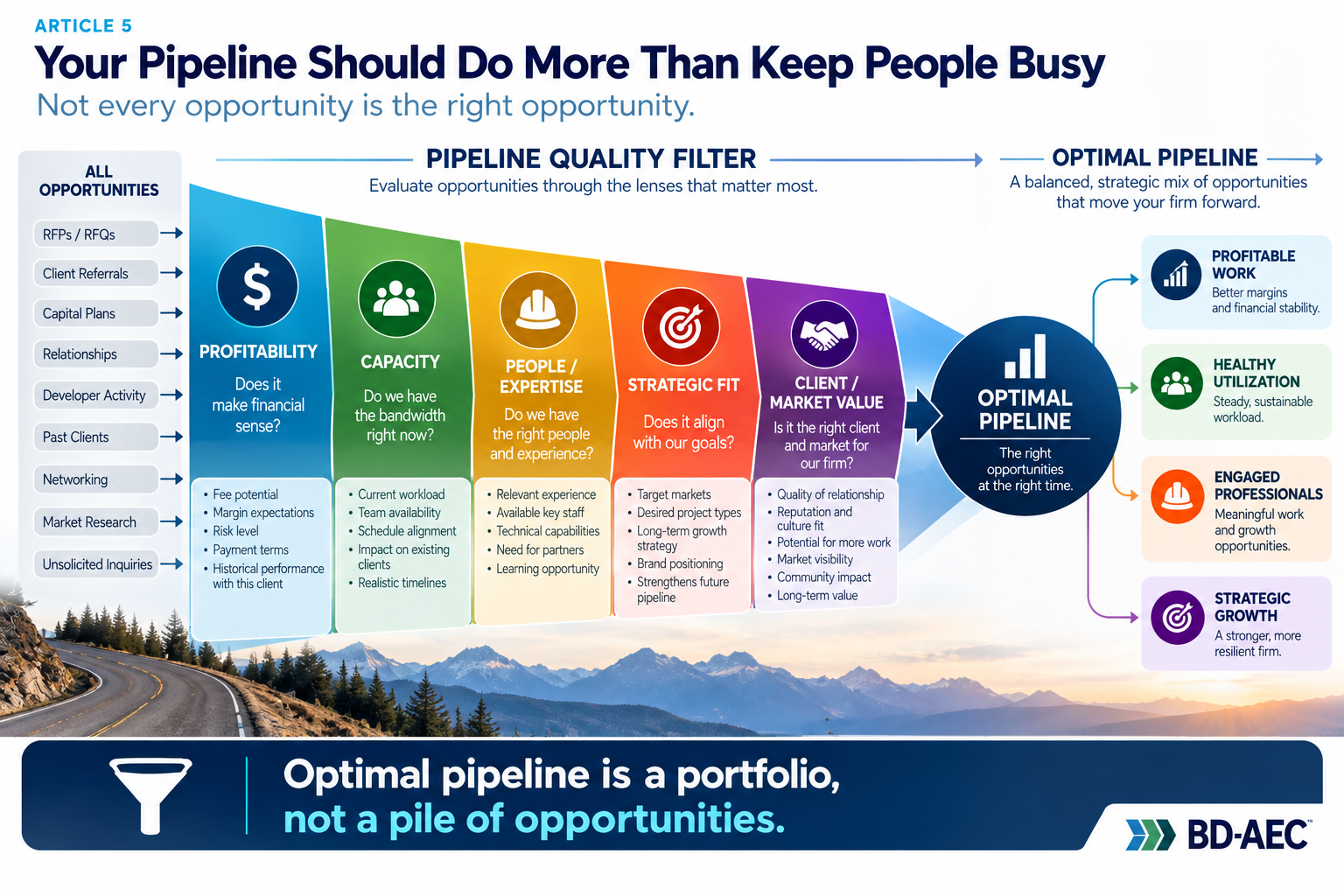
In this story 11 sections
There is a fairly simple way to think about business development: keep enough opportunities in front of the firm so that new projects replace the ones being completed. That matters, but I don’t think it goes far enough. A healthy pipeline shouldn’t merely prevent people from running out of work. It should help leadership make better use of the firm’s most valuable resources: its people, expertise, relationships, reputation, equipment, technology, and capital.
That changes the objective considerably. The question isn’t simply, “Do we have enough work coming?” The better question is, “Are we developing the right work to put our resources to their highest and best use?”
That is a much more interesting business development problem.
Pipeline Is a Resource-Utilization Strategy
Architecture and engineering firms have a particularly perishable resource: professional time. An hour of an engineer’s available capacity today cannot be stored and sold next quarter. An architect sitting without meaningful project work this week doesn’t create two weeks of capacity next week. Once that time passes, it’s gone.
That makes utilization enormously important, but utilization alone isn’t the objective. Keeping a highly experienced professional fully utilized doing low-margin work that could be performed by someone else isn’t necessarily a success. Neither is keeping an expensive technical team busy on projects that consistently require write-offs, excessive management attention, difficult collections, or uncompensated scope.
The objective should be to deploy the firm’s resources toward work where they create the greatest value. That means pipeline development needs to connect directly with operations and financial performance. Business development should know what the firm is good at selling, but leadership should also know what the firm is good at delivering profitably. Those aren’t always the same thing.
Do You Actually Know Which Work Is Most Profitable?
This is a question I think more AEC firms should be asking. Not which projects produce the most revenue, but which ones produce the best economic result.
Break the firm’s work down by client, project type, service line, geography, project manager, delivery method, and project size. Where are margins strongest? Where do write-offs occur? Which clients consistently require additional uncompensated effort? Which project types consume disproportionate senior management time? Where does scope creep occur? Which projects create repeat work? Which services allow junior staff to work effectively under senior supervision? Which clients pay reliably?
Those answers should influence business development. If the firm consistently earns stronger margins on a particular category of work, that information should eventually affect what the BD team goes looking for.
Market intelligence shouldn’t only tell us what clients want to buy. Internal intelligence should tell us what we should want to sell.
That requires more than a BD report. It requires business development, finance, and operations to share information. A pipeline built without understanding project performance is missing half of the equation.
Profitability Isn’t the Only Variable
It would be easy to stop there and say that the optimal pipeline is simply the one containing the highest-margin work. I don’t believe that either.
AEC firms are professional organizations made up of people who often care deeply about what they do. I work with a group of architects for whom affordable housing isn’t simply a market sector. They see it as part of their professional mission. The work aligns with why they became architects and with the kind of impact they want their careers to have.
I could theoretically identify another category of work with substantially higher margins and fill the pipeline with it. On a spreadsheet, that might look like excellent business development. But if the architects don’t care about the work, don’t find meaning in it, and don’t want their careers defined by it, what exactly have I optimized?
Revenue, perhaps. But probably not the firm.
People choose architecture, engineering, environmental work, planning, construction, and other AEC professions for reasons that aren’t exclusively financial. Some want to design places that improve communities. Some want to solve difficult geotechnical problems. Some want to work on transportation infrastructure. Others care deeply about historic preservation, affordable housing, environmental restoration, public infrastructure, or technically challenging construction.
Those preferences matter because engagement matters. A profitable project that nobody wants to work on has a cost that may not immediately appear on the project financial statement.
The best pipeline isn’t simply the work you can win. It’s work the organization has a reason to want.
Pipeline Begins With Understanding Who the Firm Is
This is why I don’t think business development should begin with a list of prospects. It should begin with an understanding of the firm.
Who are we? What are we exceptionally good at? What do we enjoy doing? Where do we make money? Where do we lose money? What kinds of clients do we work well with? What projects energize our people? What expertise do we want to develop? Where do we want the company to be three years from now? What work moves us toward that destination, and what work distracts us from it?
Those questions establish the boundaries for business development.
Without that understanding, BD can become little more than opportunity collection. Someone finds projects, puts them into a CRM, and celebrates because the pipeline number gets bigger. But a $20 million pipeline filled with work the firm doesn’t really want, can’t staff, isn’t particularly good at delivering, or rarely wins isn’t a $20 million asset.
It’s noise.
Utilization Has a Human Side
There is another part of utilization that firms don’t always discuss openly. Persistent underutilization can become a people-management problem.
That doesn’t mean employees should be overloaded simply to keep them occupied. Chronic overwork creates its own serious problems, and maximizing utilization shouldn’t mean driving people at unsustainable levels. Every firm also needs some available capacity for new projects, professional development, mentoring, internal improvement, unexpected client needs, and the normal fluctuations of project schedules.
But there is a meaningful difference between healthy capacity and chronic idleness.
When talented professionals don’t have enough productive work for an extended period, uncertainty has room to grow. People may begin wondering why they’re slow or what it means for their position. Minor frustrations can receive more attention. Internal complaints and politics can consume time that would otherwise be directed toward productive work. Managers can find themselves managing the consequences of underutilization rather than managing projects and developing people.
Meaningful work creates focus. It gives professionals opportunities to develop skills, solve problems, work with clients, collaborate with colleagues, and see the results of their effort. A good pipeline helps leadership maintain that productive environment without swinging to the opposite extreme of overloading the staff.
That balance should be part of the business development conversation.
The Right Pipeline Has to Match the People You Actually Have
Suppose your pipeline contains ten excellent opportunities. There is still another question: Who is going to do the work?
If every opportunity requires the same two senior engineers, you may not have as much usable pipeline as the CRM suggests. If the work requires expertise you don’t currently possess, winning it may create a recruiting problem. If one service line is overloaded while another is underutilized, adding more revenue to the overloaded group doesn’t necessarily improve the business.
Pipeline therefore needs to be understood against capacity. Which disciplines have room? Which project managers will need work six months from now? Where are we hiring? Where do we have junior professionals who need opportunities to grow? Where are senior people becoming bottlenecks? Which projects create good leverage between senior and junior staff? Which opportunities require subcontractors, new technology, equipment, or other capital investment?
These are business development questions because the answers should influence which opportunities we pursue.
A good opportunity in the wrong part of the organization may not be a good opportunity at all.
Strategic Work Can Be Worth More Than Its Margin
The analysis becomes more complicated when we consider strategic value. Sometimes a project with an average margin is worth pursuing because of what it creates beyond the immediate fee.
A project may establish a relationship with an important client, give the firm a qualification it needs to compete in a new market, provide experience for an emerging project manager, introduce a new service, create an exceptional reference project, or lead to years of repeat opportunities. The right project may even help the firm recruit and retain the kinds of professionals it wants to attract.
That doesn’t mean leadership should rationalize bad work by calling everything “strategic.” It means the value of a project isn’t always captured completely by its immediate fee and margin.
The important question is whether we understand why we want the work.
There is a significant difference between knowingly accepting a lower-margin project because it advances a specific strategic objective and discovering after the project is complete that it simply wasn’t very profitable.
Stop Treating Every Dollar of Pipeline as Equal
This is where pipeline analytics can become much more useful. Two $500,000 opportunities are not necessarily equally valuable.
One might offer strong margins, an existing client relationship, repeat potential, work the staff enjoys, an excellent fit with available capacity, and experience that supports the firm’s strategic direction. The other may require substantial pursuit costs, specialized outside resources, difficult contract terms, heavy principal involvement, limited repeat potential, and work nobody particularly wants to perform.
The CRM may say $500,000 and $500,000. Leadership should see something very different.
That’s why I don’t think pipeline management should be reduced to total dollar value and win probability. Those numbers matter, but they don’t describe the quality and composition of the pipeline.
A $10 million pipeline of the wrong work may be considerably less valuable than a $5 million pipeline that closely matches the firm’s capacity, profitability, expertise, relationships, and ambitions.
What Does an Optimal AEC Pipeline Look Like?
There probably isn’t a universal formula, and there shouldn’t be. The optimal pipeline for an affordable-housing architecture firm should look different from the optimal pipeline for a geotechnical engineering company, an electrical engineering firm, or a specialty contractor.
For a smaller AEC firm, I would think about the pipeline across several dimensions at the same time: revenue potential, profitability, likelihood of award, timing, available capacity, required expertise, client quality, repeat potential, strategic value, pursuit cost, capital requirements, and alignment with the work the firm’s professionals actually want to perform.
Those factors won’t always point in the same direction. That’s the point. Business development isn’t merely about filling a funnel. It’s about making choices.
A highly profitable project that consumes a resource you don’t have may be less attractive than it appears. A modest project for a great repeat client may be more valuable than its fee suggests. A strategically important project may justify a lower margin. A lucrative market may still be wrong for a firm whose professionals have no interest in building their careers around it.
Optimal pipeline is a portfolio, not a pile of opportunities.
This Is Why Business Development Belongs in Leadership Conversations
If business development is viewed simply as the function responsible for finding leads and responding to RFPs, most of this information never connects.
Operations knows who’s busy and where capacity is developing. Finance knows which projects and clients are profitable. HR knows where recruiting, retention, and engagement problems exist. Technical leaders know what work their people enjoy and where their expertise is strongest. Ownership knows where it wants the company to go. Business development knows what the market is doing and where future opportunities may exist.
Those perspectives need to meet. Otherwise, business development can successfully sell exactly the wrong work.
For a smaller AEC firm, this doesn’t require another committee or a complicated corporate planning process. It requires regular communication between the people responsible for finding the work and the people responsible for delivering it. The pipeline should continually change based on what they learn from one another.
This is also where business development becomes part of management strategy rather than a separate sales activity. A good pipeline gives leadership another tool for deciding when to hire, where to invest, which services to expand, which clients to pursue, where to develop talent, and sometimes which work to stop chasing.
More Work Isn’t the Objective
This is ultimately why I resist defining business development as simply generating more opportunities.
More isn’t necessarily better.
The objective is to create enough of the right work to use the firm’s resources effectively, generate appropriate financial returns, support the company’s strategic direction, develop its people, and give those people work they find worth doing.
Sometimes that means pursuing the highest-margin opportunity. Sometimes it means filling an approaching capacity gap. Sometimes it means protecting space for a strategically important client. Sometimes it means pursuing a project because the professionals in the firm genuinely care about the work. And sometimes it means deliberately walking away from revenue because the work pulls the organization in the wrong direction.
That’s what makes pipeline development a leadership function rather than simply a sales activity.
A healthy pipeline should tell you more than how much work you might win. It should reflect what the firm is good at, what it can deliver profitably, what its people want to accomplish, how its resources can best be deployed, and where leadership wants the organization to go next.
Your pipeline shouldn’t simply keep your firm busy. It should help you build the firm you’re actually trying to become.
About this story
Written byScott MannCEO | Strategic Partner, BD-AEC
- Issued
- September 28, 2026
- Corrections
- Spotted an error? Tell us.