Strategy Without Creativity Is Invisible
Strategy gives an AEC firm direction. Creativity makes that direction visible. Execution takes it into the market. What comes back should change what happens next.
 By Scott Mann, CEO | Strategic Partner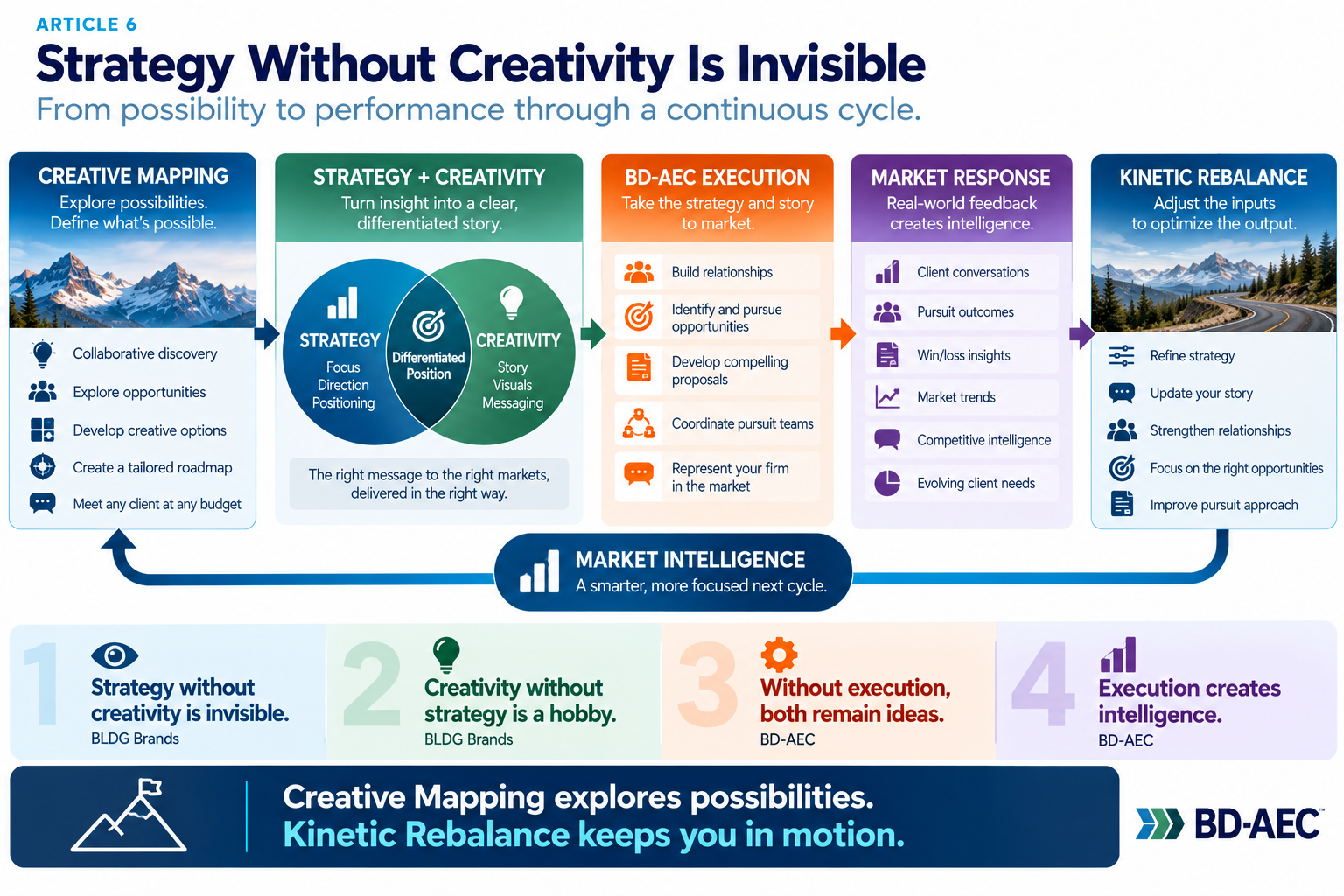
In this story 10 sections
Most AEC firms I encounter don’t suffer from a complete lack of strategy. Leadership usually has some idea where the firm wants to go. They may want to expand geographically, develop a particular market, increase work with existing clients, introduce a new service, pursue larger projects, diversify their client base, or simply generate enough profitable work to support the next stage of the company.
The strategy may be formal or informal. It may live in a strategic plan, an annual leadership retreat, a spreadsheet, or mostly in the heads of the owners. But there is usually an idea about where the firm wants to go.
The problem is what happens next. A leadership team can spend hours discussing growth strategy, identify exactly the market it wants to pursue, and make perfectly rational decisions about where the firm should invest its energy. Then it takes that strategy to market with the same website, the same qualifications package, the same project descriptions, the same introductory email, and the same story it has been telling for years.
The strategy changed. Nothing the market sees did.
Strategy and Creativity Need Each Other
Our creative partners at BLDG Brands use two statements that have become foundational to how we think about growth at BD-AEC:
Strategy without creativity is invisible.
Creativity without strategy is a hobby.
There is a lot packed into those two ideas. A firm can develop an excellent growth strategy, but if nothing changes in how the firm presents itself, tells its story, communicates its value, or engages the market, that strategy remains largely internal. The market cannot respond to a decision it cannot see.
The opposite is equally true. A beautiful website, clever campaign, memorable tagline, compelling video, or impressive qualifications package can attract attention, but creativity disconnected from a business objective can become activity for activity’s sake. Attention has value only if the firm understands what it wants to accomplish with it.
Strategy provides direction. Creativity makes that direction visible.
That is why creativity should not be treated as decoration added after the serious strategic work is complete. The important creative question isn’t simply how something should look. It is how an idea should be expressed so that the people we want to reach understand it, remember it, and potentially act on it.
Making an AEC Strategy Visible
Suppose an engineering firm decides that healthcare will become an important growth market. Leadership has done its homework. The firm has relevant experience, its technical capabilities translate well to healthcare facilities, the economics make sense, and the firm has the capacity and desire to diversify.
That may be an excellent strategy. But what does a hospital, healthcare architect, construction manager, or developer actually see?
If the website still presents the firm as a generalist, the capabilities statement gives healthcare one bullet among fifteen, and the introductory message says little more than “we would appreciate the opportunity to introduce our firm,” then the strategy exists internally but hasn’t become meaningful externally.
The firm has to determine how to make the decision visible. What is the story? Why does its experience matter to this market? Which projects demonstrate the point? What problems can it solve? What language will resonate with the people it wants to reach? What should someone remember after a ten-minute conversation? What does the website need to communicate? What should the introductory email say? What does the Business Development Director say when someone asks, “What do you guys do?”
Those are creative questions serving a strategic objective.
Good Positioning Doesn’t Invent a Better Firm
AEC professionals are trained to value accuracy. They should. Engineering has consequences, architecture has constraints, construction requires precision, and claims should be defensible. Details matter.
That mindset naturally carries into marketing. Firm descriptions often become exhaustive inventories of services, licenses, offices, software, certifications, project types, and years of experience. Everything may be technically correct while almost nothing is particularly memorable.
The challenge isn’t to become less accurate. It’s to make accurate information meaningful.
If ten engineering firms can all truthfully say they provide civil engineering, surveying, construction administration, and permitting services, repeating those services doesn’t necessarily help a prospective client understand why one firm is particularly relevant to them. The creative challenge is to find the distinction without manufacturing one.
Good positioning doesn’t invent a better firm. It makes the value of the existing firm easier to see.
The same problem occurs with the language AEC firms use to describe themselves. We provide exceptional service. We build lasting relationships. We deliver innovative solutions. We put our clients first. We have an experienced team. We are committed to quality.
Those statements may all be true, but competitors can say them too. If a statement could be placed on twenty competitors’ websites without anyone noticing the difference, it probably isn’t doing much positioning work.
Strategy should force choices about who the firm is trying to reach, what it wants to be known for, what problems it is particularly good at solving, and what kinds of opportunities it wants more of. Creativity translates those decisions into something the market can recognize.
The objective isn’t to sound clever. It’s to become clear.
Our Collaboration Exposed the Next Part of the Equation
The collaboration between BLDG Brands and BD-AEC led us to think about what happens after strategy and creativity come together. BLDG’s two statements describe an important relationship, but from a business development perspective there was another question: what happens when the strategy is sound and the creative expression is compelling, but nobody consistently takes either one into the market?
That led us to the third statement:
Without execution, both remain ideas.
Strategy and creativity can both happen in a conference room. Business development cannot. Eventually, someone has to make the call, send the email, arrange the introduction, attend the event, schedule the meeting, pursue the opportunity, introduce the principal, submit the qualifications, and follow up afterward.
This is particularly important for smaller AEC firms because project delivery will always compete with business development for attention. A strategy session can create tremendous enthusiasm on Tuesday, but by Thursday a client has a problem, a proposal is due, and everyone is back to delivering projects. The strategy may still be good and the creative ideas may still be compelling. They simply never traveled far enough into the market to produce anything.
That is where BD-AEC’s role becomes important. We don’t want strategy and creative work to end as a presentation, a new website, a campaign, or a collection of marketing materials.
We take the ideas to market.
Execution Creates Intelligence
Once we began thinking about execution, we realized there was another part of the equation:
Execution creates intelligence.
Execution does more than create activity. It gives the market an opportunity to respond.
We can sit around a conference table and discuss what we believe clients care about. We can identify target markets, develop positioning, refine the story, and create materials we believe will resonate. Then we start talking to people, and the market begins telling us what we got right and what we got wrong.
Prospects ask questions we didn’t anticipate. Certain messages create immediate interest while others fall flat. Clients tell us what they’re struggling with. We hear how people perceive the firm. We discover competitors we weren’t watching. We hear about projects that aren’t yet public. We learn why a firm won or lost. We begin to see changes in buying behavior, priorities, and attitudes.
Those conversations produce market intelligence.
That intelligence shouldn’t simply sit in a CRM as a meeting note. It should go back into the strategy, positioning, creative work, relationships, and pursuits. The market is giving us information that should influence what we do next.
In that sense, execution isn’t merely the last step in a strategy.
Execution should improve the strategy.
From Creative Mapping to Kinetic Rebalance
This is where BLDG Brands’ Creative Mapping and BD-AEC’s Kinetic Rebalance fit together.
Creative Mapping is exploratory. It creates a structured opportunity to consider possibilities, challenge assumptions, develop ideas, and create a creative roadmap around where the firm wants to go and how that direction might be expressed.
Creative Mapping asks us to consider what could be.
Kinetic Rebalance begins from a different premise: the firm is already in motion.
The AEC firms we work with aren’t sitting still waiting for someone to create a strategy. They are designing buildings, solving engineering problems, managing projects, serving clients, writing proposals, hiring people, attending meetings, pursuing opportunities, and generating revenue. They already have energy moving through the organization.
The question is whether that energy is producing the output the firm wants.
Maybe too much effort is going toward poorly aligned pursuits. Maybe the firm has a strong technical capability that the market doesn’t understand. Maybe its story no longer reflects what the company has become. Maybe principals are spending too much time on activities that could be supported by a business development function. Maybe a market everyone believed would be attractive isn’t responding, while an unexpected opportunity is gaining traction.
Kinetic Rebalance is about adjusting those inputs based on what we are learning.
Creative Mapping explores the possibilities. Kinetic Rebalance adjusts the inputs. BD-AEC takes them to market.
Your Firm Is Already in Motion
The word kinetic matters because we don’t approach an operating AEC firm as though it is a body at rest. These companies already have people, clients, projects, relationships, reputations, processes, strengths, weaknesses, and ambitions. They already possess energy.
The goal is to direct that energy more effectively.
Suppose a firm is putting enormous effort into responding to public solicitations but rarely winning. The answer might not be to pursue more opportunities. The rebalance could involve pursuing fewer projects and investing more heavily in relationships, positioning, or better go/no-go decisions.
Another firm may have excellent client relationships but weak positioning. Its technical professionals are respected, but the market doesn’t clearly understand the full range of problems the firm can solve. The rebalance might require more emphasis on storyline and creative communication.
Another firm may have a compelling brand and plenty of visibility but weak follow-up. The problem isn’t creativity. It’s execution.
A different firm may enter the market convinced that a particular service will open doors, only to discover through conversations that clients are much more interested in another capability. The market is giving the firm information. Kinetic Rebalance means being willing to respond to it.
This isn’t a one-time strategic exercise. It is a continuous process of adjusting the inputs while the organization remains in motion.
The Market Gets a Vote
This may be the most important consequence of combining strategy, creativity, execution, and market intelligence.
Leadership doesn’t get to decide by itself whether the strategy works.
The market gets a vote.
Clients respond to meetings. Prospects respond—or don’t respond—to outreach. Selection committees create shortlists and awards. Partners make referrals. Opportunities develop in unexpected directions. Employees respond to the work the firm chooses to pursue.
Sometimes the market confirms exactly what we believed. Sometimes it tells us something completely different.
That isn’t necessarily failure. It’s information.
A growth system should be capable of absorbing that information and responding to it. This is where the traditional idea of creating a strategy and then simply “executing the plan” can become incomplete. Execution shouldn’t only implement strategy. It should create the intelligence that helps the strategy evolve.
For smaller AEC firms, this can be a significant advantage. A $3 million engineering company may be able to hear something from the market on Tuesday, discuss it with leadership on Wednesday, and change its approach on Thursday. There may be no layers of corporate approval standing between market intelligence and action.
The challenge is making sure the information actually reaches the people who can use it.
Closing the Loop
This is how the complete idea has developed through the collaboration between BLDG Brands and BD-AEC.
Strategy without creativity is invisible. — BLDG Brands
Creativity without strategy is a hobby. — BLDG Brands
Without execution, both remain ideas. — BD-AEC
Execution creates intelligence. — BD-AEC
The fourth statement is what turns the equation into a loop rather than a straight line. Intelligence comes back into the system. We learn what the market is telling us, adjust the strategy, refine the story, reconsider the relationships and opportunities we’re pursuing, and take the next version back into the market.
We learn. We adjust. We rebalance. Then we execute again.
That’s why Creative Mapping and Kinetic Rebalance aren’t competing ideas. They address different parts of the same growth process. Creative Mapping creates space to explore possibilities and develop the creative direction. Kinetic Rebalance continually adjusts the growth inputs as real-world information becomes available. Execution connects those ideas to the market, and market intelligence closes the loop.
Strategy + Creativity + Execution Creates Growth
That leads to the equation we use at BD-AEC:
Strategy + Creativity + Execution creates GROWTH.
Not because every strategy will be right, every creative idea will resonate, or every pursuit will become a project. They won’t.
Growth comes from developing a direction, making that direction visible, taking it into the market, listening carefully to what comes back, and having the willingness to adjust. The objective isn’t to create the perfect strategy and then defend it from change. It is to build a growth system capable of learning.
Creative Mapping explores possibilities. Kinetic Rebalance adjusts the inputs. BD-AEC takes them to market.
Then we listen to what the market tells us, learn from it, and do it again.
That is much closer to how growth actually happens.
About this story
Written byScott MannCEO | Strategic Partner, BD-AEC
- Issued
- September 28, 2026
- Corrections
- Spotted an error? Tell us.