The Next Growth Opportunity Might Be a Person
An AEC firm’s growth strategy needs to account for both the work it wants to win and the people it needs to deliver it. That’s why BD-AEC is adding talent acquisition.
 By Scott Mann, Founder + Lead Business Development Director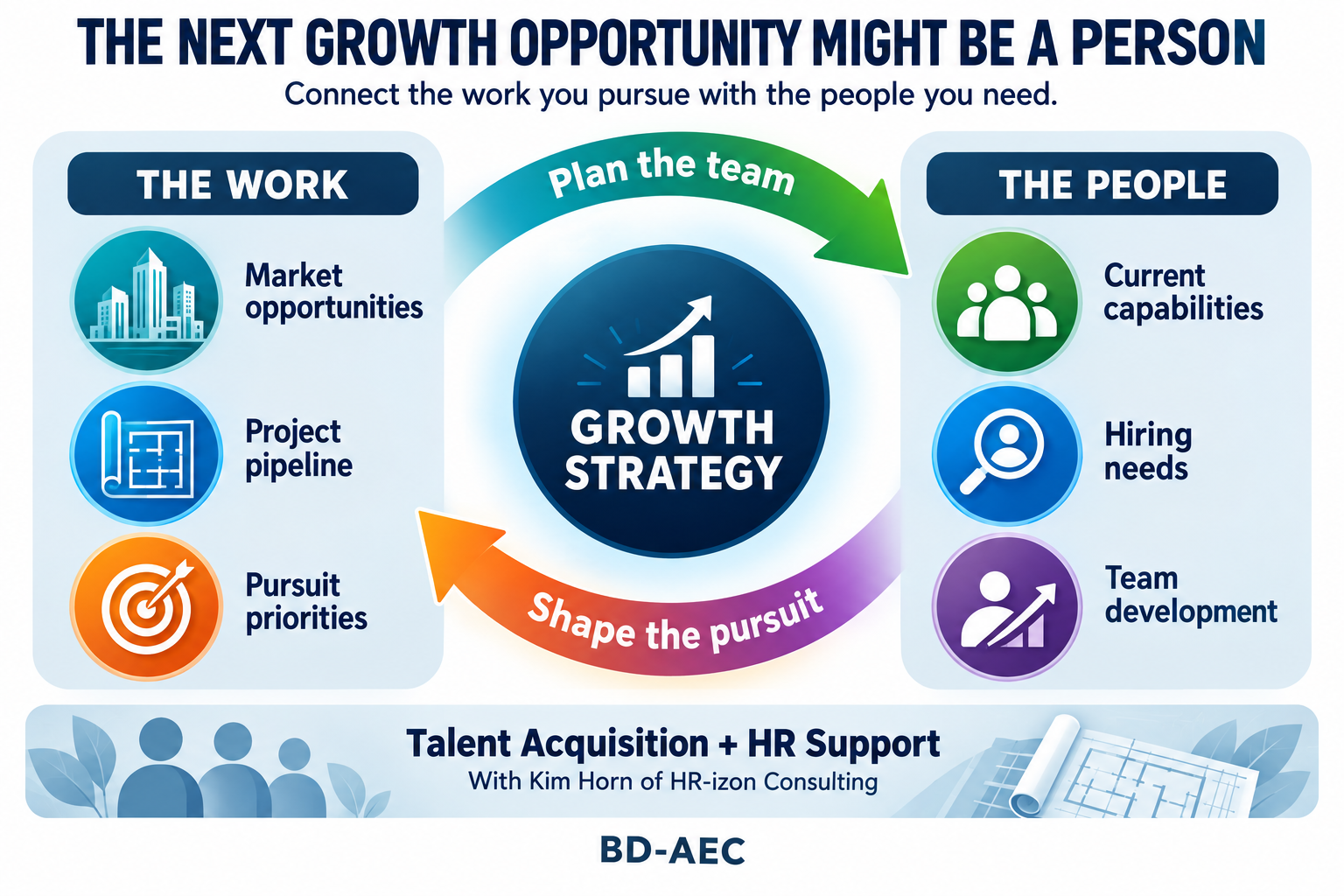
In this story 7 sections
A recent conversation with a business development professional at an architecture and engineering firm in the Indianapolis area prompted me to expand what BD-AEC offers. We are adding talent acquisition, with recruiting and HR support from Kim Horn, founder of HR-izon Consulting.
For me, this connects directly to the purpose of business development. We help firms identify opportunities, develop relationships, position themselves, and win appropriate work. But every growth conversation eventually reaches another question: Who is going to do the work? A firm can have strong relationships, a clear market position, and opportunities worth pursuing. Its ability to act on those opportunities still depends on the people available to deliver them.
That deserves a place in the business development conversation. If we are helping a firm grow, we should understand both the opportunities available in the market and the workforce needs that will influence its ability to pursue them.
The Pipeline and the Team Need to Be Discussed Together
In an earlier article, I wrote about why a pipeline should do more than keep people busy. It should reflect the firm’s expertise, resources, economics, and ambitions. People are central to that equation because the composition of the team affects both what the firm can deliver today and what it can reasonably pursue next.
Consider an engineering firm with an opportunity to expand a service line. The clients are there, the firm has relevant experience, and leadership believes the market makes sense. But the expansion depends on hiring an experienced engineer who can manage the work and develop the team. Until that person is in place, an important part of the growth plan remains unresolved.
Business development needs to understand that dependency. Which pursuits can the existing team support? Which opportunities depend on a new hire? When would that person need to start? What happens if the search takes longer than expected? Those answers should influence both the pursuit calendar and the hiring plan.
The reverse matters, too. If the firm hires ahead of demand, business development needs to understand what work will put that additional capacity to productive use. The pipeline helps explain whom we need to hire, while the team helps determine what we should pursue. Leadership gets a more useful picture of the business when those conversations happen together.
Sometimes One Hire Changes What a Firm Can Pursue
Hiring can add capacity, but it can also add capability. Another professional may help a firm deliver more of the work it already performs. A different hire may bring experience that supports a new project type, strengthens a technical team, or gives an emerging service line the leadership it needs. Those are different hiring objectives, and they should produce different searches.
Suppose a small architecture practice wants to pursue more renovation work. Before recruiting, leadership should understand what is missing. Does it need another production architect, someone experienced in existing-building conditions, or a project manager who can coordinate complicated occupied-space projects? A broad instruction to “find us an architect” leaves too much unresolved.
The search becomes more useful when the firm can explain what the person should make possible, which responsibilities they will own, and how their experience will complement the people already on the team. Leadership should also understand what work it expects to pursue once that person is in place.
That clarity benefits candidates as well. Someone considering a move should be able to understand why the position exists, what the firm wants them to accomplish, and how the role fits into the company’s direction. A defined opportunity gives both sides a better basis for deciding whether the fit makes sense.
Hiring Needs Someone Responsible for Moving It Forward
Smaller AEC firms often ask the same leaders to manage clients, review technical work, pursue opportunities, and interview candidates. Each responsibility matters, and each competes for time. Recruiting can become another important activity that receives attention only when project demands allow it.
A recruiting effort requires more than identifying someone who might be interested. Candidates need to be sourced, screened, and evaluated against the role. Interviews need to happen, questions need answers, and someone needs to coordinate the process with the firm’s decision makers. Meanwhile, project deadlines continue, and a promising candidate can become another item waiting for attention on an already crowded calendar.
This is a familiar organizational problem. The firm knows something needs to happen, but responsibility for moving it forward is spread across people whose primary obligations are elsewhere. Without clear ownership, the process can lose momentum even when everyone agrees the hire is important.
Technical leaders still need to evaluate technical suitability, and leadership still needs to make the hiring decision. But they benefit from having support around those decisions, just as they benefit from research, coordination, and preparation around a business development meeting.
Define the Role Around the Business Need
Before a search begins, I think leadership should be able to explain what problem the position is intended to solve. Is the firm short of production capacity? Are too many decisions dependent on one senior engineer? Does an emerging project manager need experienced support? Is leadership trying to develop a new service, or does a principal need to transfer responsibilities so the company can grow? Those situations may call for very different people.
A job description can list credentials, years of experience, and software proficiency. Those details matter, but they should connect to the responsibilities the person will actually carry. If leadership expects someone to manage projects, supervise staff, develop clients, improve processes, and establish a new service line, the search needs to reflect that combination of expectations.
The firm also needs to consider whether it has defined a realistic role. Sometimes the hiring conversation reveals that leadership has combined several organizational needs into one position without deciding which responsibilities matter most. Working through those priorities before recruiting gives the firm a clearer basis for evaluating candidates and explaining the opportunity.
A useful hiring plan starts with what the organization needs someone to accomplish. The qualifications should follow from that understanding.
Bringing Kim Horn Into the Work
Kim Horn, PHR, PMP, brings more than 20 years of experience in human resources, recruiting, talent acquisition, and organizational leadership. As the founder of HR-izon Consulting, she works with organizations to strengthen people practices, develop leaders, and address workforce challenges. Her background includes strategic HR leadership, recruiting, employee relations, organizational development, and executive coaching.
Kim is also a veteran and the author of Human Latency: Dismantling the Silent Drag on Elite Execution, which explores the gap between knowing what needs to be done and being able to take action. Her work brings another perspective to the organizational challenges that can affect performance and growth.
Through this collaboration, BD-AEC can help AEC firms source architects and engineers, with support for candidate screening, qualification, and coordination throughout the hiring process. The starting point is understanding the firm, the position, and the need behind it. Search scope and fees are discussed for each engagement.
Filling the Position Is One Part of the Growth Plan
Finding a candidate deserves careful attention. So does preparing the organization for that person to succeed. Will the new hire have clear responsibilities? Who will manage them? What support will they need? What decisions can they make, and how will leadership evaluate their progress? These questions become especially important when a firm is creating a position it has never had before.
An experienced project manager still needs to understand how the firm operates. A new technical leader needs clarity about their authority. Someone hired to develop a service line needs agreement about priorities, resources, and expectations. Experience helps, but it does not substitute for direction from the organization.
Hiring someone capable does not remove the firm’s responsibility to create the conditions in which that person can contribute. Through HR-izon Consulting, HR and leadership support can help firms address those needs alongside recruiting. The objective is to bring someone into a role that the organization has thought through and is prepared to support.
Build the Team Around the Firm You Want to Become
Business development remains the center of BD-AEC’s work. Talent acquisition adds another way to help firms act on their growth plans by connecting the opportunities they want to pursue with the people they need to deliver them.
The connection runs in both directions. The pipeline helps leadership understand what people the firm may need, and the team’s capabilities help leadership understand what work the firm should pursue. Those conversations should inform one another as opportunities develop, project schedules change, and the organization’s needs evolve.
Before opening the next position, ask what the hire is intended to accomplish. Before committing to the next pursuit, ask what people will be needed to deliver it. Then build the plan around both, because the work you pursue and the people you hire should help you build the same firm.
To discuss the architects or engineers your firm needs next, learn more about talent acquisition and HR support through BD-AEC.
About this story
Written byScott MannFounder + Lead Business Development Director, BD-AEC
- Issued
- October 12, 2026
- Corrections
- Spotted an error? Tell us.