Your Firm Is Already in Motion. Is It Building Momentum?
More opportunities, more proposals, and more marketing don’t automatically create better growth. Kinetic Rebalance examines where an AEC firm’s effort is going, and whether that allocation supports the business leadership wants to build.
 By Scott Mann, Founder + Lead Business Development Director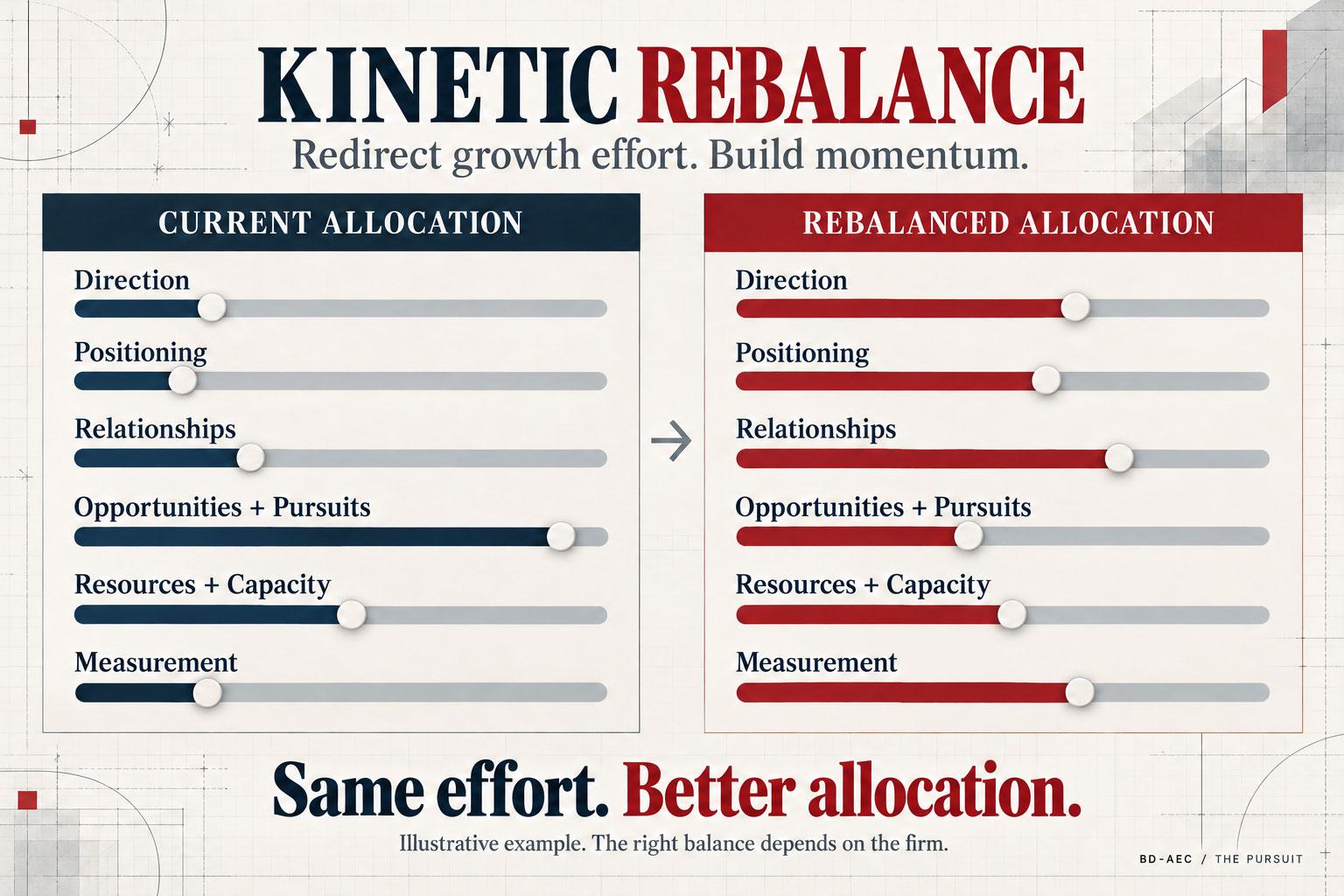
In this story 7 sections
An architecture, engineering, or construction (AEC) firm can have a very busy business development calendar without making much progress toward its growth goals.
Proposals are going out. Principals are attending events. Someone is updating the website. Client meetings are happening. Opportunities are being tracked, introductions are being made, and the next deadline is already approaching.
Meanwhile, leadership may still be asking why the firm isn’t winning more of the work it wants. Why a promising market hasn’t developed. Why an important capability remains difficult to sell. Or why growth keeps adding pressure without creating the business the owners intended.
Those questions deserve attention before the firm adds another layer of activity.
At BD-AEC, we call that examination Kinetic Rebalance: understanding how a firm is directing its growth effort, then adjusting the inputs to make that effort more productive.
The starting point is an operating business with people, clients, projects, relationships, and ambitions already in motion. The question is whether those parts are working together in the direction leadership wants to go.
Inertia Can Look Like a Full Calendar
Inertia is easy to mistake for inactivity. In an AEC firm, it can look like the opposite.
The same events remain on the calendar. The same project types fill the opportunity list. The same qualifications language appears in the next proposal. Principals continue handling business development in the gaps between project responsibilities.
Each activity may have a reasonable explanation. A conference once produced an important relationship. A particular client has been good to the firm. A market helped establish its reputation. A principal has always been the person who opens doors.
The issue is whether those choices still serve the business.
A firm changes as its people develop, its capabilities expand, and its clients’ needs evolve. An activity that made sense five years ago may deserve a different level of attention today. Continuing it without reconsidering its purpose can keep the organization moving along a familiar path while leadership hopes for a different destination.
That’s what we mean when we say:
Inertia is the enemy.
The habit worth challenging is continuing to allocate growth resources the same way simply because that’s how the firm has always operated.
Find the Constraint Before Adding Activity
A request for more leads sounds straightforward. But it assumes the shortage of leads is the problem.
Sometimes it is. A firm may need access to additional buyers, better market intelligence, or more consistent relationship development.
Another firm may already have plenty of opportunities. Its difficulty is deciding which ones deserve attention. A third may have respected technical professionals whose capabilities are poorly understood outside their existing client base. A fourth may be creating demand faster than its delivery team can absorb it.
Those situations call for different responses.
Before prescribing more activity, leadership needs to understand what’s preventing the existing effort from producing the desired result. Is the firm spread across too many markets? Does its story explain why its experience matters? Are principals spending their limited time on the right relationships? Are pursuits being selected deliberately, or does every available RFP become another deadline?
The answers should influence the allocation of effort.
A new campaign will have limited value if the firm hasn’t decided whom it wants to reach. More opportunities can create additional strain if the team lacks the capacity to deliver them. Better proposal writing helps, but it can’t make every poorly matched pursuit a good investment.
Kinetic Rebalance begins with the business behind those requests.
Growth Inputs Need to Reinforce One Another
An AEC firm’s growth effort extends beyond outreach and proposals. It includes market focus, intelligence, differentiation, positioning, relationships, visibility, opportunity development, people, and measurement.
These inputs affect one another.
Choosing a priority market should influence which relationships the firm develops. Those conversations should reveal what buyers value. That understanding should sharpen the firm’s story and help determine which project examples belong in its qualifications materials. Pursuit decisions should account for both the opportunity and the resources needed to deliver it.
When those connections are weak, a firm can spend considerable effort maintaining activities that point in different directions.
Marketing may be promoting one capability while principals pursue another. A service line may receive plenty of visibility without anyone responsible for following up. The opportunity list may be growing while the technical team is trying to reduce workload.
The answer is to examine how the parts fit together and what deserves attention first.
The goal is to find the right balance of growth effort.
That may require additional investment in one area, a reduction in another, or a change in who owns the work.
A Rebalance May Mean Fewer Pursuits
Consider a technically strong engineering firm with relevant project experience and a good reputation. It regularly responds to public solicitations yet rarely wins the strategic projects leadership wants.
The immediate response might be to find more solicitations.
A closer examination could reveal that the firm is concentrating most of its effort near the deadline. It has spent less time defining priority buyers, explaining its differentiation, developing relationships, and evaluating whether each opportunity warrants a response.
In that situation, more proposals could repeat the same pattern.
A rebalance might involve a narrower market focus, more deliberate qualification, stronger project stories, and earlier conversations with prospective clients and partners. Some opportunities would receive more attention. Others would be passed over.
The total effort might remain similar. Its allocation would change.
The firm could spend less time assembling responses for loosely matched opportunities and more time creating the conditions that make a well-matched pursuit worth undertaking.
That’s an illustrative example, not a universal prescription. Another firm might have excellent relationships and clear positioning but need more disciplined pursuit execution. The appropriate adjustment depends on what the business reveals.
Delivery Capacity Belongs in the Conversation
Growth decisions also need to account for the people who will do the work.
A promising market may depend on hiring someone with a particular capability. A principal may be the only person able to manage a certain project type. A growing backlog may conceal a workload that leaves little room for training, quality control, or the next strategic opportunity.
Business development needs to understand those conditions.
We have discussed this connection in The Next Growth Opportunity Might Be a Person. The pipeline helps leadership understand what people the firm may need, while the team’s capabilities influence what the firm can responsibly pursue.
A rebalance could therefore involve changing the mix or timing of opportunities, strengthening hiring support, or reserving principal involvement for the relationships and decisions that most need it.
The objective is growth the organization is prepared to deliver.
The Growth Engine Organizes the Work
Kinetic Rebalance and the BD-AEC Growth Engine have related but distinct roles.
The Growth Engine provides the operating structure for developing opportunities, positioning the firm, building relationships, pursuing work, and learning from the response.
Kinetic Rebalance examines where effort should be concentrated within that structure.
A firm may need stronger positioning before increasing outreach. Another may need better follow-up around relationships it already has. Pursuit outcomes may reveal that qualification deserves more attention, or that the market is responding to a capability leadership had underestimated.
Those findings should change the next allocation of effort.
The Embedded BD Department provides the people, process, and resources to put those priorities into practice. Research, relationship development, creative materials, proposals, pipeline management, and follow-up become part of the execution required to support the agreed direction.
A useful rebalance should reach the calendar: what receives attention, who takes responsibility, and what changes next.
Start With Where the Effort Is Going
Leadership doesn’t need to wait for an annual planning retreat to begin examining the balance.
Look at the opportunities the firm is pursuing, the relationships receiving attention, the hours principals are spending on business development, and the work those activities are producing. Compare that effort with the clients, projects, and capabilities leadership wants to develop.
Then ask where the connections are breaking down.
Which activities are helping the firm become better positioned for its desired work? Which continue mainly through habit? What deserves more support? What could be reduced? What needs to change before adding another pursuit to the list?
Those questions create a more useful growth conversation because they begin with the organization as it operates today.
Your firm already has effort moving through it. Kinetic Rebalance helps determine where that effort should go next, and what needs to change for the inputs to reinforce one another.
Better alignment. Greater momentum. Sustained acceleration.
To discuss where your firm’s growth effort could be better directed, start a conversation with BD-AEC.
About this story
Written byScott MannFounder + Lead Business Development Director, BD-AEC
- Issued
- October 16, 2026
- Corrections
- Spotted an error? Tell us.