What Should a Growing AE Firm Invest in Business Development?
Before deciding what percentage to invest in business development, define the work. Scott Mann examines the complete BD function, published industry perspectives, and the investment growing AE firms should consider.
 By Scott Mann, Founder + Lead Business Development Director
In this story 11 sections
The percentage becomes more useful when we understand the work it needs to support.
An engineering firm might describe its business development budget as the salary of its BD Director. Another might point to what it spends on marketing, conferences, and proposals. A third might include the time its principals and project managers devote to developing relationships and pursuing work.
Each is describing a real investment. They may also be describing substantially different portions of the same function.
That makes the familiar question—“What percentage of revenue should we spend on business development?”—difficult to answer until we establish what belongs in the calculation.
Before discussing the percentage, I think we need to examine the work.
What Business Development Investment Includes
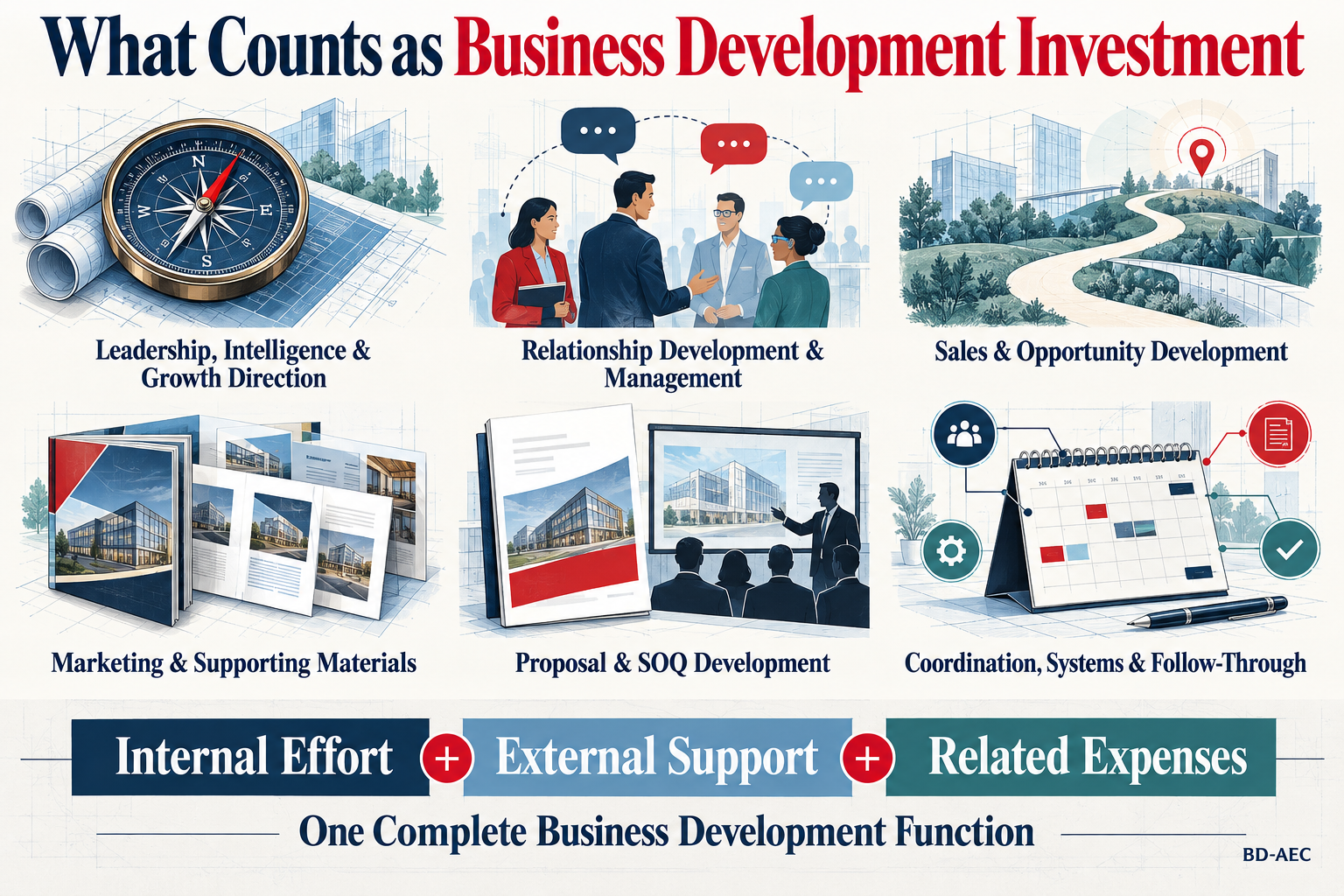
I think about business development as the coordinated work of understanding the market, developing and maintaining relationships, creating opportunities, communicating the firm’s value, and pursuing appropriate projects.
That work requires people, time, supporting materials, and consistent attention. Some of those resources may exist inside the firm. Others may come from outside partners.
Our services at BD-AEC provide a useful model for understanding the scope. Leadership, market intelligence, strategy, relationships, sales, marketing materials, proposals, and follow-through all contribute to the same objective: helping the firm develop and win the work it wants.
The framework is consistent. Its application needs to reflect the individual business.
Two civil engineering firms may understand the same technical disciplines and compete in similar markets while having different capabilities, relationships, economics, capacity, and ambitions. Their business development investment should reflect those differences.
Understanding the Business and Choosing Its Direction
Someone needs to understand what the firm is trying to accomplish.
Which work does leadership want more of? Where does the firm have a credible advantage? Which clients fit its capabilities? What can its people deliver? Where would additional work improve the business, and where would it create pressure the organization is unprepared to manage?
Answering those questions takes time. So does understanding the market in which the firm intends to compete.
That is why onboarding, market intelligence, growth planning, and Kinetic Rebalance belong within the investment. They help connect what the market offers with what the individual firm should pursue.
A budget that supports activity without supporting those decisions can keep people occupied while leaving the direction unresolved.
Developing Relationships and Advancing Opportunities
Relationships require attention before, during, and after a particular pursuit.
A firm needs to develop new connections. It also needs to maintain relationships with existing clients, former clients, owners, agencies, developers, contractors, architects, and other potential teaming partners.
That work includes conversations when there is nothing immediately available to bid.
Sales belongs in this definition too. In an AE business, sales involves understanding a potential client’s needs, explaining the firm’s relevance, developing the opportunity, involving the right technical professionals, and helping the conversation move toward a decision.
The cost includes the people doing that work and the resources supporting their participation. Meetings, travel, conferences, and association involvement may all contribute.
The registration fee is only part of a conference investment. The preparation, attendance, technical participation, and follow-up require time as well.
Making the Firm’s Value Understandable
A firm’s experience needs to be understandable to someone considering hiring it.
That requires positioning and a coherent story, supported by materials that demonstrate what the firm can do. Capabilities statements, project descriptions, case studies, staff resumes, photography, presentations, brochures, and website content all have a role.
Some materials support an immediate conversation or pursuit. Others become assets the firm uses repeatedly.
A well-developed project description can support several proposals. A clear capabilities statement can help a potential partner recognize where the firm belongs on a team. An updated resume can make a technical professional’s relevant experience easier to evaluate.
Developing and maintaining those materials is part of BD investment.
Pursuing Work Through Proposals and SOQs
Proposal and Statement of Qualifications development also belongs within the function.
The work extends from evaluating whether an opportunity deserves attention through pursuit strategy, team coordination, writing, editing, production, and interview preparation when required.
It includes the contribution of principals and technical staff.
An engineer who spends an afternoon developing the technical approach has contributed to the pursuit just as surely as the person coordinating the submission. Both have a cost, even if their time appears in different places in the accounting system.
The firm also benefits when the pursuit improves the materials and knowledge available for future opportunities. That requires attention beyond getting the submission out the door.
Coordinating the Work
Someone has to keep these activities connected.
Relationships need follow-up. Meetings need preparation. Opportunities need evaluation. Materials need updating. Principals and technical staff need enough context to contribute effectively. Leadership needs visibility into what is happening.
The people, systems, and administrative support that keep this work moving are part of the investment.
Together, these responsibilities describe a substantial business function. A firm may distribute them across employees and outside partners, but the work still needs ownership.
Internal Effort and External Support Belong in the Same Calculation
An outside invoice is visible. Internal effort can be less obvious.
The principal attending a client meeting, the project manager contributing to an SOQ, and the administrator coordinating a pursuit are all committing resources to business development.
Their time belongs in the calculation alongside external BD support, creative services, proposal assistance, and related expenses.
For internal planning, I would use compensation and related employment costs attributable to that time. The potential billable revenue associated with professional capacity is a separate consideration. Adding both as though they were independent expenses would overstate the cost.
The same discipline applies elsewhere. If proposal support is included in an external engagement, do not count that fee again as a separate purchase. If an employee’s allocated BD time already appears in the labor total, do not add the same hours under another heading.
The objective is a complete picture without double counting.
That definition also needs boundaries. Technical project delivery remains a delivery cost. Hiring an engineer to perform additional projects is a workforce investment. General overhead does not automatically become BD because it helps the company operate.
The expense should have an identifiable connection to the growth function.
Revenue Needs a Definition Too
The denominator matters as much as the expenses.
For this discussion, I use annual net service revenue. Zweig Group defines that as gross revenue less subconsultants and reimbursable expenses. It is not net profit. Zweig Group’s financial definitions.
That provides a more useful basis for comparing the scale of an architecture or engineering firm’s own services.
Construction revenue cannot be compared directly with AE service revenue. A contractor’s gross revenue includes a substantially different mix of materials, subcontracted work, and other project costs. Applying the same percentage to those two revenue bases would produce a misleading comparison.
What Published Industry Opinions Tell Us
Rich Friedman addressed the spending question in his March/April 2020 article for NSPE’s PE magazine, “Finalizing Your Marketing Budget? Ask These Four Questions to Maximize Your Planning.”
He described average AEC marketing and BD spending of 5–6% of net service revenue, including labor. He also observed that fast-growing firms sometimes spent 8–10%.
His larger argument was that a budget should follow what the firm needs to accomplish. He questioned how consistently firms account for labor and emphasized that greater spending does not necessarily produce better results.
I agree with those distinctions. An industry average can help leadership examine its assumptions. It cannot decide what a particular firm’s growth plans require.
PSMJ offers a useful challenge to the idea that growth necessarily demands a higher percentage.
In “Marketing Spend: Are Your Budgets Targeted for Growth?”, John Doehring discussed findings from PSMJ’s 2015 research. Its Circle of Excellence firms reported marketing investment of 3.9% of net service revenue, compared with 5.2% for all respondents, while reporting stronger revenue and backlog growth.
The implication deserves attention: how effectively a firm directs its investment matters.
Those findings do not demonstrate that reducing a budget creates growth. They do challenge anyone recommending a larger commitment to explain what the additional resources are intended to accomplish.
These are historical publications, rather than current spending prescriptions. Their arguments remain useful because they expose the limitations of treating a percentage as the answer.
My Position for a Growing AE Firm
For an architecture or engineering firm with approximately $500,000 to $15 million in annual net service revenue that is deliberately pursuing growth, I believe total BD investment should generally be closer to 10%.
I mean the combined investment in internal effort, external support, and related expenses across the function described here.
My reasoning begins with the amount of work involved. A growing firm needs to maintain existing relationships while developing new ones. It needs to understand opportunities, communicate its capabilities, pursue work, and keep those activities moving while its technical staff deliver current projects.
It may also need to strengthen the materials, leadership, and coordination supporting that effort.
Those needs deserve an explicit resource commitment. Otherwise, the growth plan can depend on work that everyone agrees is important but nobody has sufficient capacity to carry forward.
At $2 million in annual net service revenue, a 10% planning figure represents $200,000 across the entire function. It does not mean a $200,000 outside engagement. Some of that investment may already exist in principal participation, employee time, proposal effort, and other spending.
The first step is understanding what is already being committed. The next is deciding whether that commitment supports what leadership expects the business to accomplish.
The Percentage Has to Serve the Business
I take PSMJ’s efficiency argument seriously. Spending more on poorly selected pursuits, unclear positioning, or activity without follow-through will not resolve those problems.
The same scrutiny should apply to a low budget. A modest percentage may reflect an effective growth function. It may also reflect incomplete accounting, deferred relationship development, or an unrealistic reliance on principals’ available time.
The number alone cannot tell us which.
My recommendation is to plan for a complete BD function and examine whether an investment approaching 10% appropriately supports the firm’s ambitions. Then hold that investment accountable to its purpose.
Leadership should understand what the resources are intended to accomplish, who owns the work, and whether the effort is helping the firm develop the relationships and opportunities it wants.
The appropriate investment begins with understanding the business. The percentage gives that conversation a scale. The work gives it meaning.
About this story
Written byScott MannFounder + Lead Business Development Director, BD-AEC
- Issued
- November 4, 2026
- Corrections
- Spotted an error? Tell us.