The First Meeting Went Well. What Happens Next?
A prospective client mentioned a problem. What you do next helps them decide whether they can trust you and helps you decide whether there’s work worth pursuing.
 By Scott Mann, Founder + Lead Business Development Director
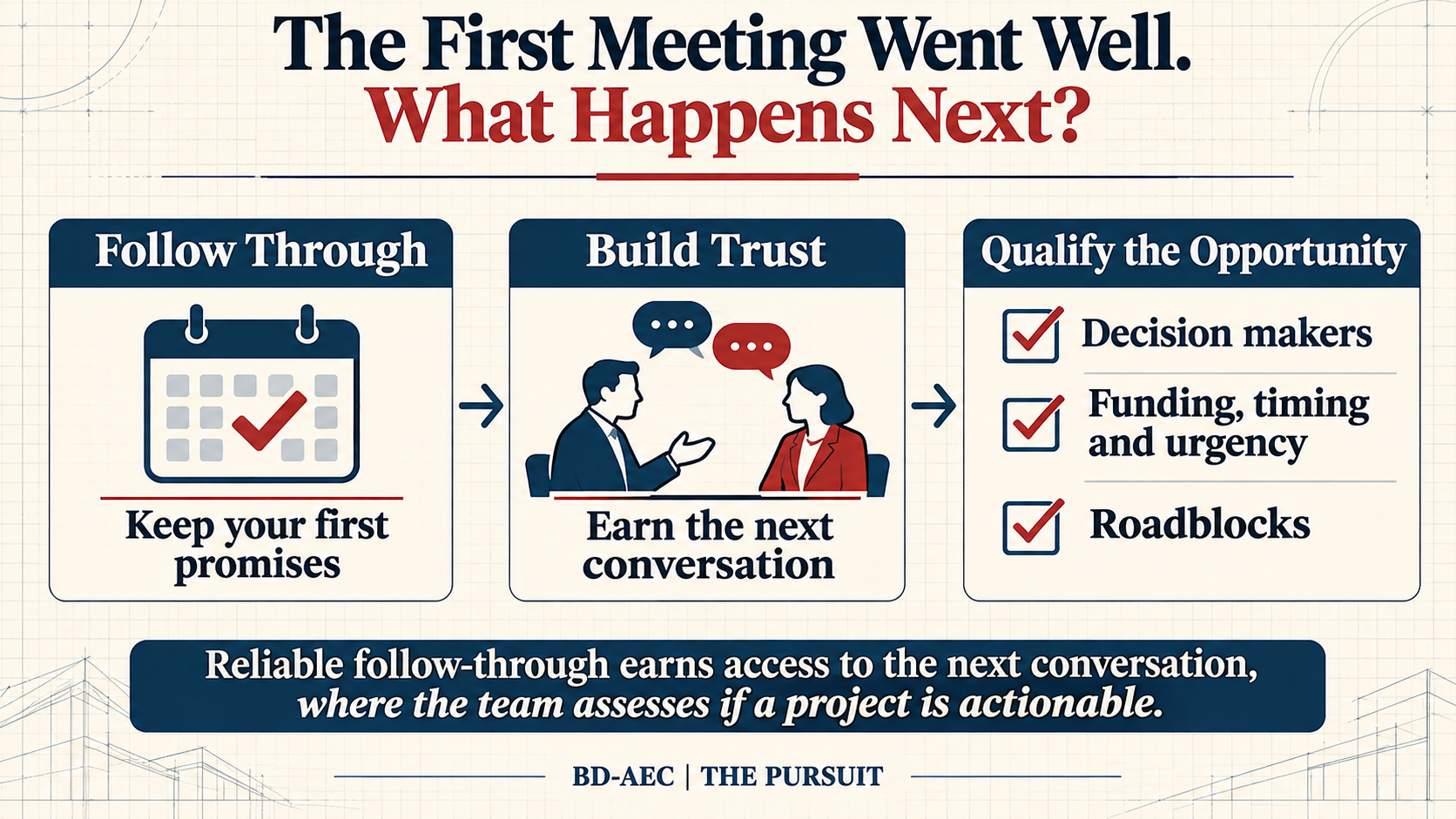
In this story 5 sections
Imagine we’re doing business development for an engineering firm that works with manufacturers. We see that a company is adding a production line at a local plant. A contractor who knows the facility introduces us to the facilities director, and she agrees to a 30-minute conversation about what’s changing at the plant and how the company handles facility improvements.
The new line is already covered. But the director mentions something else. Whenever the plant moves equipment, maintenance spends time tracing utility connections because the drawings don’t reflect what’s on the floor. She’d like to get ahead of it before the next layout change. She hasn’t discussed the issue with operations or set aside a budget.
We’ve learned something worth following up on. The director is also learning something about us. She’s watching how we handle the commitments we make before she decides whether to bring us further into her business.
Trust Starts With the First Few Interactions
Before the meeting, did we tell the director why we wanted to meet, who would be there, and how much time we were asking for? Did we arrive early enough to handle check-in, dress professionally for the setting, and show up ready to talk about her facility? If we promised to send an example of similar work by Thursday, did she get it by Thursday?
Those are small commitments, and they’re the ones the client can see us make and keep. If we miss the first deadline or send a page of marketing material when she asked for one relevant example, she has reason to wonder how we’ll handle a commitment that matters to her shutdown schedule.
This is part of qualifying an opportunity, too. We may need the director to introduce us to operations, share information about the plant, or arrange access for a walkthrough. Each of those steps asks her to spend time or put her credibility behind us. Delivering on the first few things we promise gives her a reason to do that.
Confirm What You Heard and Ask for One Next Step
I’d send the information we promised and give the director a chance to confirm what we heard. The note might read like this.
Here’s the project example we discussed. You also mentioned that maintenance has to trace utility connections whenever equipment moves. Is there a layout change already on the schedule? If so, would it help to walk that part of the plant with you and the people from operations or maintenance who would be involved? We could look at where the gaps in the drawings are causing trouble and decide whether it makes sense to define a scope.
If she can point to an upcoming move and bring the maintenance lead into the conversation, there’s a reason to invest more time. If the next move is still a long way off, we can agree on when to check back and follow through when we said we would.
Can the Client Move This Forward?
Suppose the director invites us to the plant. Maintenance shows us where the drawings disagree with what’s installed. Operations is considering moving two pieces of equipment during a planned shutdown. I’d bring an engineer who understands work in operating facilities so we can ask better questions about the scope and timing.
The walkthrough can confirm the problem. The follow-up tells us whether the manufacturer can do something about it. Before we spend time developing a scope and fee, I want answers to three questions.
Have I found the people who can make the decision? The facilities director may be the person who gets the work moving. The plant manager may decide whether it’s a priority, operations may control the shutdown, and purchasing may issue the contract. I’d ask the director how a similar assignment was approved and who should join the next conversation.
Can they authorize the work, make time for it, and give it priority? Where would the funding come from, and who can approve it? Who controls the shutdown schedule and can give our team access to the plant? What happens if they leave the issue alone until the next equipment move? The answers tell us whether the people who can act have enough reason to do it now.
What could stop an assignment from going ahead? The shutdown could move. Maintenance might decide to do the work internally. Purchasing may require the company to use an existing vendor or approve a new one. I’d ask what could hold this up even if everyone in the room wanted it done.
Decide How Much to Pursue
If the plant manager confirms the move is a priority, there’s a credible path to funding, and our engineer can define work we can deliver profitably in the available window, we have a reason to develop a fee. The budget may still be taking shape. I want to know who can approve it and what they need from us to make that decision.
If everything hinges on the shutdown schedule, agree on who will confirm it and when we’ll reconnect. If maintenance can handle the immediate issue without outside engineering, say so. That gives the client a useful answer and shows how we’ll use our judgment when they ask for help again.
I’d record what we learned, what we promised, who owns the next step, and when it’s due. “Follow up” can sit in a pipeline for months. “Send the project example by Thursday and reconnect after operations sets the shutdown schedule” gives someone a commitment to keep and a reason to get back in touch.
Where BD-AEC Stays Involved
Through BD-AEC’s embedded Growth Engine, I help firms carry the relationship forward after the introduction. I follow up on what we promised, find out who needs to be involved, and bring in technical staff when their judgment can help. I work with firm leadership to decide how much time the opportunity deserves and stay involved as it moves toward a scope and fee. By then, the people preparing the proposal know what the client is trying to decide, who can move it forward, and what might get in the way.
If your pipeline is full of good conversations that never seem to go anywhere, let’s look at a few together. We’ll start with what each prospect told you, what you promised to do next, and what would give both sides a reason to keep going.
About this story
Written byScott MannFounder + Lead Business Development Director, BD-AEC
- Issued
- November 27, 2026
- Corrections
- Spotted an error? Tell us.