You Found the Project When the RFP Came Out. So What?
For small and mid-sized AEC firms, discovering an opportunity when it is advertised isn’t necessarily a failure of business development.
 By Scott Mann, CEO | Strategic Partner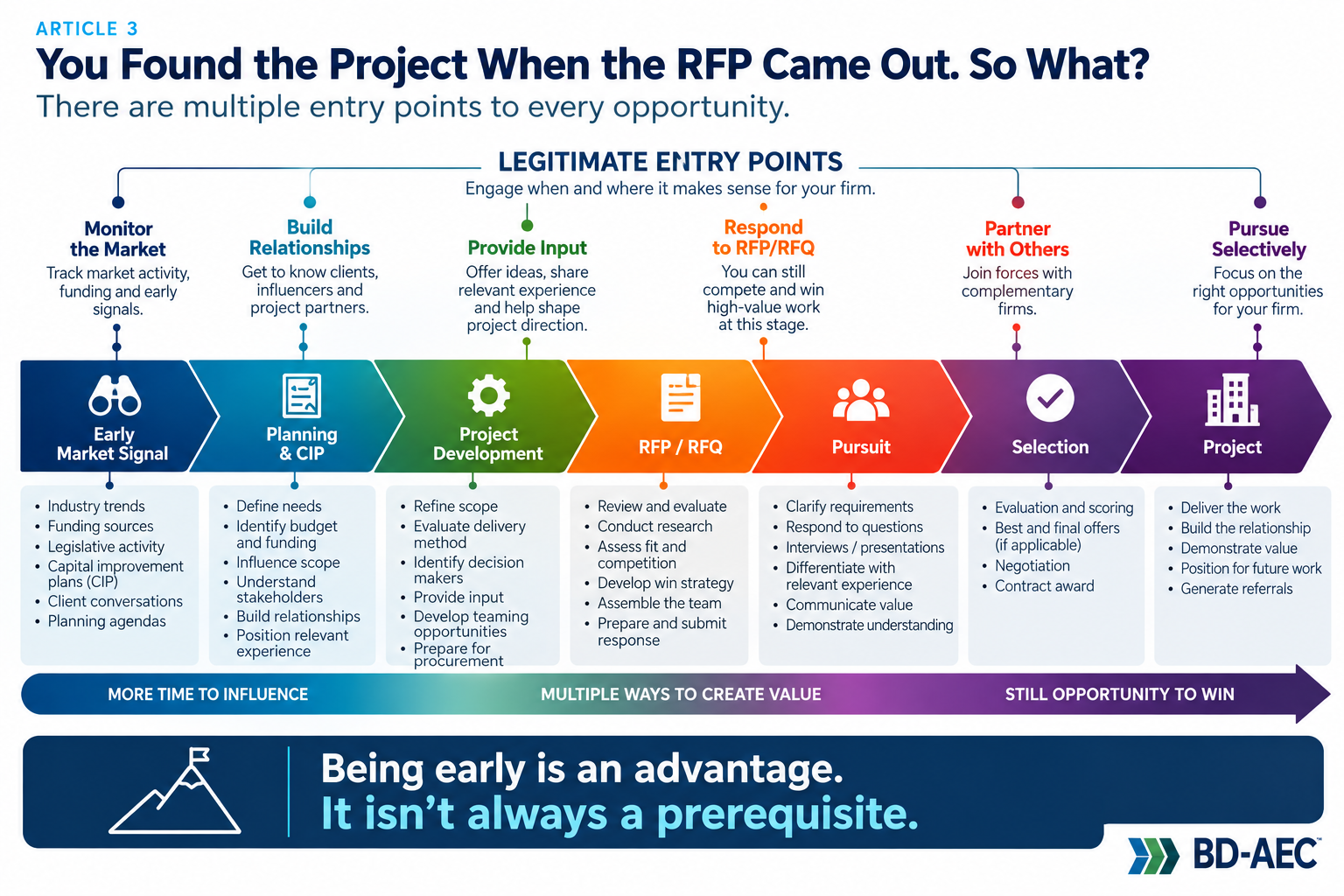
In this story 8 sections
There is a familiar piece of advice in AEC business development: “If you’re finding out about the project when the RFP comes out, you’re already too late.”
There is truth behind that statement. There is also a lot of exaggeration.
If your firm has been working with a municipality for years, understands its Capital Improvement Plan, knows its infrastructure needs, and has participated in conversations that helped shape a future project, you are in an enviable position. You understand why the project exists, what the client is trying to accomplish, who is involved, and perhaps even some of the issues that will ultimately drive the selection. That is excellent business development.
But it isn’t how every project is won, particularly in the market where smaller and mid-sized AEC firms compete. For a $500,000 to $20 million architecture, engineering, construction, or specialty firm, the more useful question often isn’t, “Why didn’t we know about this two years ago?” It’s “Now that we know about it, can we win it?”
Getting Upstream Is the Goal, Not the Requirement
The ideal business development scenario is easy to understand. Your firm has an established relationship with a client. Through regular conversations, you understand the organization’s problems and future needs. In the public sector, perhaps you know the Capital Improvement Plan and understand which projects are likely to receive funding. You may even participate in conversations that help the agency think through a future improvement before a formal project exists.
When the RFQ or RFP eventually appears, you aren’t discovering the project. You’ve been watching it develop.
That is the holy grail of AEC business development, and firms should pursue those relationships whenever they can. But we should be careful about turning an ideal position into a universal rule for deciding whether an opportunity is worth pursuing.
In the markets where I work, I routinely see projects under roughly $5 million awarded to firms that had nothing to do with creating the project and may not have known it existed until the solicitation was released. That doesn’t mean relationships and early intelligence don’t matter. It means being early is an advantage, not always a prerequisite.
We Talk About “Getting Upstream” More Than We Actually Do It
Business development professionals like talking about being upstream of opportunities. We develop relationships years in advance. We influence Capital Improvement Plans. We identify funding. We understand projects before they become projects. We position instead of chase.
All of those things can happen, and when they do, they can create a meaningful advantage. But look honestly at the opportunities a typical smaller AEC firm pursues during a year. How many did the firm genuinely help create? How many were identified years in advance? How many resulted from a deliberate capture strategy that began long before procurement?
Usually, it’s some of them. It’s rarely all of them.
Smaller firms have limited business development resources. Their principals and technical leaders are often still managing projects, serving clients, reviewing work, recruiting employees, and running the company. They cannot spend years positioning for every potential $500,000 or $2 million project that might eventually materialize.
That doesn’t mean they should abandon long-term relationship development. It means their business development system also needs to be very good at recognizing and acting on opportunities that appear today.
Finding an RFP Late Doesn’t Mean You Can’t Win
Suppose an RFQ comes out tomorrow for a project you’ve never heard of. Does that automatically mean you should pass?
I don’t think so.
The first question should be whether the opportunity makes sense for your firm. Do you have relevant experience? Can you assemble a credible team? Does the project fit the type of work you want? Do you have the capacity to perform it? Can you develop a meaningful understanding of the client and project in the time available? Does anyone in your organization or network have a relationship that can help you learn more? Is there evidence that another firm has a substantial positioning advantage? And, most importantly, can you develop a compelling reason for the client to select you?
Those questions tell us much more than simply asking whether we knew about the project before the solicitation.
Sometimes the answers will tell us not to pursue. Perhaps an incumbent has overwhelming experience. Maybe another firm helped develop the project and has relationships we can’t realistically overcome. Maybe our qualifications are marginal, the schedule is bad, or the pursuit would consume resources better used somewhere else.
That is useful intelligence.
But “We just heard about it” is not the same thing as “We can’t win it.”
Early Intelligence Is Valuable, but It Isn’t Magic
Knowing about a project early gives a firm something extremely valuable: time. Time to understand the client, develop relationships, think about the team, learn about the project, and determine how the firm should position itself.
But early knowledge doesn’t automatically turn into an award.
A firm can know about an opportunity for two years and still pursue it poorly. It can have an established relationship and misunderstand what the client values. It can be the incumbent and lose. It can spend considerable time positioning only to discover that another team has better qualifications or a more compelling approach.
Conversely, a firm can discover a project when the RFQ is published, recognize that its experience fits exceptionally well, assemble the right team, do excellent research, develop a strong story, and win.
Business development should give us advantages wherever we can create them. Early intelligence is one of those advantages. It simply isn’t the only one.
An RFP Can Be the Beginning of a Relationship
This is particularly important for growing firms.
If we decide that we should only pursue clients where we already have strong relationships, how do we develop new clients?
Sometimes the pursuit itself creates the relationship. A firm sees an opportunity, researches the organization, identifies the people involved, learns what the client is trying to accomplish, and submits a thoughtful response. Maybe the firm gets shortlisted and suddenly its principals and technical professionals are sitting across the table from a client they had never met 60 days earlier.
Maybe they win. Maybe they don’t.
Either way, a relationship now exists where one didn’t exist before.
That matters because a good business development system should learn from every meaningful pursuit. Who did we meet? What did we learn about the organization? What did the client respond to? What other needs became apparent? Who else should we know? Is this an organization we want to continue pursuing?
A solicitation discovered today can become the beginning of a relationship that produces work for years.
The RFP Database Isn’t the Enemy
There is also a tendency among business development professionals to dismiss procurement databases and bid services as though using them somehow represents unsophisticated business development.
I don’t agree.
They are tools.
If a service identifies a project that fits our capabilities, leads us to an opportunity we otherwise would have missed, and ultimately helps us win profitable work, then it provided value.
The problem isn’t using an RFP database. The problem is mistaking an RFP database for your entire business development program.
A healthy pipeline can include opportunities from existing clients, referrals, relationships, Capital Improvement Plans, public records, teaming partners, developer activity, industry conversations, market research, digital tools, and formal procurement notices. Those sources complement one another.
For a smaller firm with limited resources, using technology to cast a wider net can be especially useful. The business development skill comes in determining which of those opportunities deserve attention.
The Real Skill Is Knowing What to Chase
Finding opportunities isn’t particularly difficult anymore. The harder problem is deciding which ones deserve the firm’s limited resources.
A $5 million engineering firm cannot pursue everything that appears to fit its capabilities. Every pursuit consumes something: principal time, technical staff time, proposal resources, research, teaming effort, graphics, meetings, and attention that could have been directed somewhere else.
That makes the go/no-go decision one of the most important parts of business development.
An opportunity discovered through a longstanding relationship can still be a bad pursuit. An opportunity discovered yesterday through an RFP alert can still be an excellent one.
What matters is the quality of the fit.
Does the project align with what the firm does well? Is it work the firm actually wants? Can it be performed profitably? Do we have the right experience? Do we have capacity? Can we assemble the right team? Is the client attractive? Does the opportunity support where the firm wants to go? Can we develop a credible position in the time available?
Those are much better questions than whether the project arrived through the “right” business development channel.
Market Intelligence Still Matters
None of this diminishes the importance of market intelligence. It simply gives market intelligence a more practical definition.
Market intelligence isn’t only knowing about projects before everyone else. It is understanding enough about the market, clients, competitors, opportunities, and your own firm to make better decisions.
Sometimes that intelligence develops over several years. Sometimes you have several weeks to build it.
When a new opportunity appears, the work begins immediately. Why is the client doing the project? What problem are they actually trying to solve? What has the organization done previously? Who are the decision-makers? Who is the incumbent? What firms are likely to compete? What does the solicitation emphasize? What can we learn from people who know the organization? Where are we strong? Where are we vulnerable? What does our team offer that matters to this particular client?
Good business development professionals need to be capable of long-term positioning, but they also need to be able to develop useful intelligence quickly.
For smaller AEC firms, that second skill is especially important.
The Goal Isn’t to Be Early. The Goal Is to Be Positioned.
I would always rather know about a good opportunity earlier.
More time creates more options. It gives us time to develop relationships, learn, build the team, and shape our position. If an important client is planning future work, I want to know about it.
But I don’t believe an AEC firm should measure the quality of its business development program by how many projects it knew about before the RFP appeared.
The better measure is whether the firm consistently identifies the right opportunities and puts itself in a credible position to win them.
Sometimes that positioning begins years before procurement.
Sometimes it begins when an email alert arrives on Tuesday morning.
The business development challenge is knowing the difference between an opportunity where you are genuinely too late and one where you simply arrived later than you would have preferred.
So get upstream whenever you can. Develop relationships before you need them. Understand your clients’ Capital Improvement Plans. Pay attention to funding, growth, leadership changes, and future needs. Those activities create real advantages.
But don’t turn good business development advice into mythology.
If the right project hits the street tomorrow and you’ve never heard of it, the question isn’t whether you’re late. The question is whether you can get positioned to win.
About this story
Written byScott MannCEO | Strategic Partner, BD-AEC
- Issued
- September 28, 2026
- Corrections
- Spotted an error? Tell us.