When the Answer Keeps Being No
A lost pursuit can consume the resources and confidence of several firms. When losses become a pattern, examine the opportunity decisions, teaming arrangements, competitive assumptions, and story behind the next response.
 By Scott Mann, Founder + Lead Business Development Director
In this story 15 sections
A series of unsuccessful pursuits deserves more than another proposal. It can be a reason to examine what the firm is offering, whom it is pursuing, which partners it brings, and whether its story still reflects the business.
One unsuccessful pursuit is disappointing. Several in a row can begin to affect how a firm sees itself.
The team works hard. Qualifications are assembled. Technical professionals contribute their time. Someone makes sure the response meets the requirements and arrives before the deadline.
Then another firm is selected.
Sometimes there is useful feedback. Sometimes there is little explanation. Occasionally, the firm struggles to get a meaningful response at all.
Eventually, someone asks what needs to change.
The immediate answers often concern the proposal. Improve the writing. Find better project examples. Change the format. Bring in a different teaming partner. Pursue more opportunities.
Any of those actions could help. But a series of noes can also justify a broader conversation.
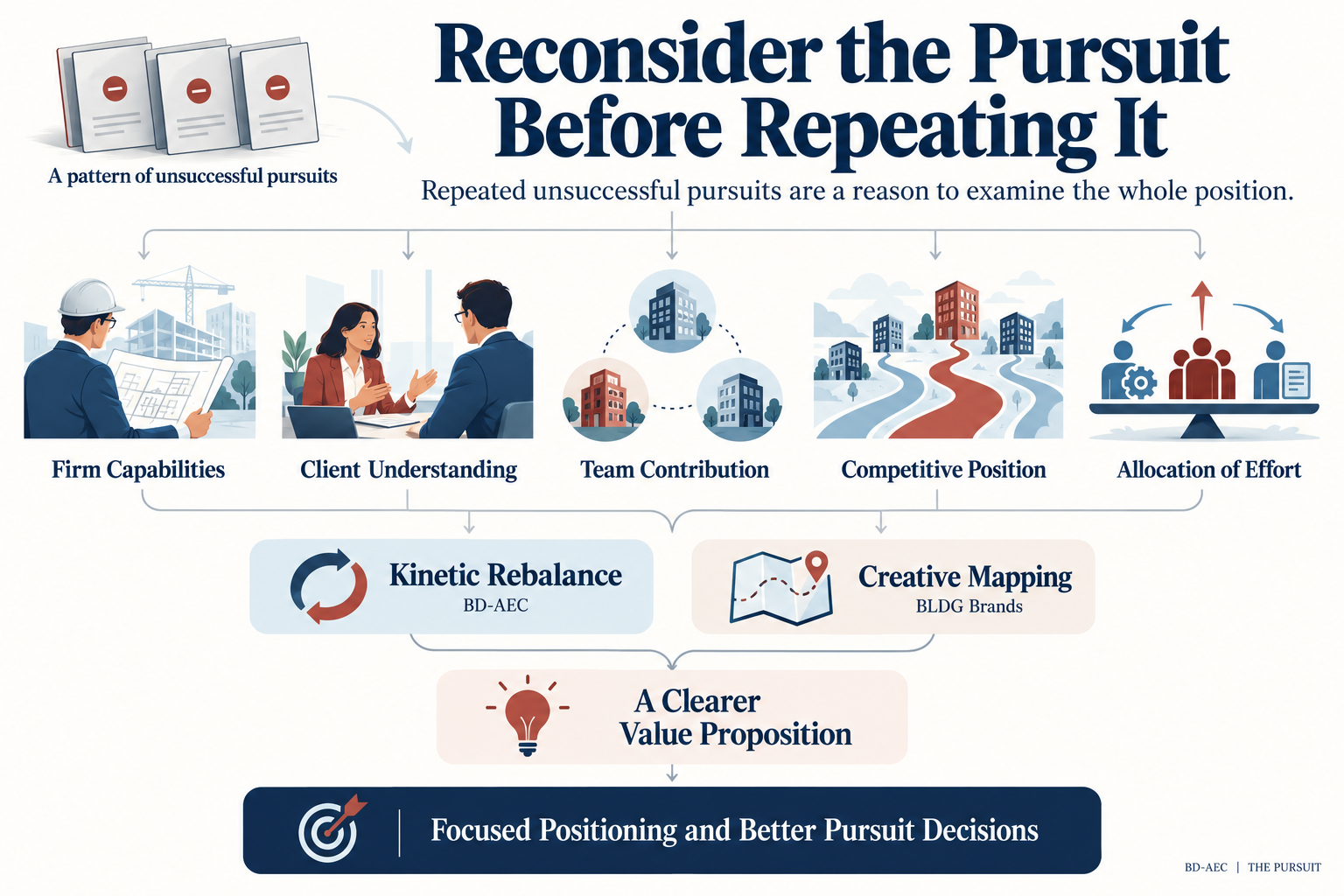
Are we pursuing work that fits the firm we are today? Do we understand what the client values? Can we explain why our experience matters? Did we assemble a team with a credible reason to be selected? Have changes inside the business left us telling a story that no longer holds together?
And have we reconsidered the competition as carefully as we have reconsidered ourselves?
Before asking everyone to invest in another response, leadership may need to look inward—and take a fresh look at the market.
A Series of Losses Is a Signal to Investigate
Losing several pursuits does not establish that the firm’s strategy is broken.
The opportunities may have been unusually competitive. Another team may have had stronger experience or an established relationship. Projects may have changed, been delayed, or disappeared. The firm may have made reasonable decisions and still been unsuccessful.
Those possibilities deserve examination.
But so does the possibility that the pattern is telling us something about our own choices.
Perhaps the firm is stretching its experience across too many markets. Perhaps it has become less competitive in work it continues to pursue out of habit. Perhaps the capabilities receiving the most attention are no longer the ones that give the business its best opportunity.
The useful response is curiosity supported by evidence.
Which pursuits were credible opportunities? Where did we reach the shortlist? What did clients tell us? Which concerns appeared more than once? What did the selected teams offer that we could not demonstrate?
A pattern deserves more attention than an isolated result. It still needs interpretation.
The Investment Extends Beyond Your Own Firm
The consequences become more complicated when a pursuit involves several firms.
An architect, civil engineer, structural engineer, landscape architect, specialty consultant, and contractor may each contribute people, qualifications, project examples, technical thinking, and coordination time.
Every participating firm has made a decision to spend resources on the opportunity. Those resources could have supported another pursuit, a client relationship, or billable work.
Someone inside each organization may also have advocated for joining the team.
That person has put judgment and credibility behind the decision. They may have told colleagues that your firm understands the issuer, has a meaningful relationship, brings unusual experience, or has identified an opportunity worth their attention.
If the pursuit fails, they may need to explain why the investment made sense.
A proposal loss can therefore affect more than your own win rate. It can influence whether other firms want to pursue the next opportunity with you.
Your Partner Is Making a Decision About You
In a conversation with a senior engineer at a long-established firm, she described a highly selective approach to public pursuits.
Her firm wanted to be involved early, have an established relationship, and pursue work it believed it was positioned to win. Teaming partners needed to contribute something consequential: a relationship with the issuing organization, significant relevant project experience, or another clear advantage.
She also described the internal consequences of losing. Partners who supported an unsuccessful pursuit could take a substantial political hit.
That context helps explain why an invitation to team is more than a request for a resume and a project sheet.
The prospective partner is evaluating the opportunity, but it is also evaluating your judgment.
Why are you pursuing? What do you know? What do you bring? Why do you believe this combination of firms belongs in the competition?
Their willingness to participate may depend on whether they believe your answers.
That does not mean every firm should adopt the same pursuit philosophy. I have written previously about why discovering an opportunity when the RFP appears does not automatically make it unwinnable.
But if your proposed partner operates under a different standard, you need to understand that before asking it to commit.
Did We Choose the Right Partners?
After an unsuccessful pursuit, it is reasonable to examine the team itself.
Did we select firms whose experience supported this particular assignment? Did the proposed people strengthen the response? Were their roles clear? Did the combination address the issuer’s priorities, or did we assemble familiar names without establishing why they belonged together?
A collection of respected firms is not automatically a compelling project team.
One partner may have excellent credentials but little experience relevant to the assignment. Another may bring a useful relationship but lack the capacity to provide the proposed personnel. A third may be technically strong while doing little to distinguish the team from competitors.
Those are different contributions and different limitations.
The question is what the team needed to demonstrate—and whether its composition helped make that case.
We should also ask how effectively we used the capabilities available. Did the response explain the partners’ relevance? Did the interview make their contribution clear? Did they receive enough context to participate meaningfully?
Sometimes the problem is the selection of partners. Sometimes it is how the team is organized, positioned, and presented.
Did We Deliver What Our Partners Expected?
The examination needs to run in both directions.
It is easy to ask whether our partners helped us win. We should also ask whether they believe we brought what justified their involvement.
If we represented ourselves as having a strong relationship with the issuer, how substantial was it? If our value was relevant experience, did we demonstrate it convincingly? If we were leading the pursuit, did we provide the direction, coordination, and execution the team needed?
There is a difference between losing a competitive selection and failing to deliver an agreed contribution.
No firm can guarantee an award. A partner can still reasonably expect honesty about the opportunity, credible positioning, clear responsibilities, and follow-through.
If those expectations are repeatedly disappointed, another invitation may not come.
The partner may have limited resources for future pursuits. It may be protecting the internal credibility of the person who supported teaming with you. It may simply conclude that another firm offers a stronger basis for the next investment.
That is why the debrief should include an honest conversation about the teaming experience. What did each firm believe it was joining? What worked? What was missing? Would the combination make sense again, and under what circumstances?
A pursuit can leave relationships stronger even after a loss. That requires taking the partners’ experience seriously.
Look at the Firm That Exists Today
An AE firm changes over time.
People develop new expertise. Others leave. Certain services become more important. Some markets become less attractive. Leadership makes decisions about where it wants to concentrate resources.
The firm’s public story does not always keep pace.
A website may still emphasize broad capabilities while the business has become more focused. Qualifications language may describe services that are now difficult to staff. A project portfolio may document an impressive history without making the firm’s current direction understandable.
That disconnect can affect prospective clients and potential partners.
Leadership needs a clear view of what the business can offer today. What can we deliver well? Where do we have depth? Which experience remains relevant? What work produces a healthy economic result? Which assignments fit the people and resources available?
It should also understand what belongs within the firm and where complementary partners strengthen the offering.
Those questions can be uncomfortable when the organization is changing. They are necessary.
A fresh value proposition needs to begin with an honest understanding of the firm behind it.
Recognize What Is Still Strong
Introspection should include strengths as well as weaknesses.
After repeated disappointments, leadership can become preoccupied with the missing qualification, the competitor’s larger team, or the market position it has struggled to establish.
Meanwhile, valuable capabilities receive too little attention.
There may be a particular problem the firm understands exceptionally well. A technical leader may have experience that matters to a different group of clients. A modest project may demonstrate judgment more clearly than the larger assignments dominating the qualifications package.
Existing clients and teaming partners may value something the firm barely mentions.
Why do they return? Which people do they ask for? What do partners consistently need from us? Where does our participation make their team more credible?
Those answers can help identify a defensible basis for future growth.
The objective is to understand where the firm’s strengths meet a need someone has a reason to buy—or a capability another firm has a reason to include.
The Competition Has Not Been Standing Still
A firm can become familiar with its competitors and gradually stop examining them.
We know their names. We have seen their qualifications. We remember which projects they won and where we have beaten them.
But that understanding can become dated.
Competitors may be recruiting different people, developing capabilities, strengthening relationships, assembling new teams, and reconsidering how they explain their value. They may be learning from the same kinds of disappointments that are prompting us to look inward.
The firm we competed against two years ago may present a different proposition today.
That matters because clients evaluate alternatives. Our experience may still be relevant while another team has become more compelling. A capability that once distinguished us may now be widely available. A competitor may have become better at explaining a strength it possessed all along.
The same applies to teaming relationships. A partner who previously depended on our expertise may now have additional options. Another firm may bring stronger project experience, better access to the issuer, or a combination of capabilities we have not recognized.
We should be willing to reconsider what we think we know.
Who is appearing on the teams being shortlisted? What experience are they emphasizing? Which people have joined them? What are clients telling us about the selected team? Where has our understanding been overtaken by changes in the market?
Those questions belong alongside the examination of our own firm.
Kinetic Rebalance needs current market intelligence. Otherwise, we risk adjusting our effort against a competitive picture that no longer exists.
Use Kinetic Rebalance to Examine Where the Effort Is Going
At BD-AEC, Kinetic Rebalance begins with an operating business already in motion.
The firm has people, relationships, experience, commitments, and growth effort moving through it. The question is whether that effort is directed toward the outcomes leadership wants.
A string of unsuccessful pursuits provides a reason to examine that allocation.
How much attention is going to opportunities where the firm has a limited chance of being selected? Which relationships receive consistent investment? Where is senior technical time being consumed? Which teaming arrangements are earning continued confidence?
The answers may suggest a different emphasis.
A firm might concentrate on fewer markets, develop relationships earlier, strengthen evidence around a particular service, or become more selective about when it leads a pursuit.
It might also recognize that its strongest near-term position is as a specialist on another firm’s team. Leading every pursuit is not necessarily the best use of a capability that makes other teams stronger.
Another business may have the experience to lead but need better access to issuers and more deliberate partner relationships.
The appropriate rebalance depends on what the examination reveals.
The goal is to decide what deserves more effort, what should receive less, and what needs to change before another deadline takes over the calendar.
Creative Mapping Can Help Explore a Different Direction
Understanding the current situation is part of the work. Leadership also needs room to consider what the firm could become known for next.
BLDG Brands’ Creative Mapping approach contributes by helping explore possibilities, challenge assumptions, and develop creative direction.
Which audiences might value the firm’s experience? What problems connect its capabilities? Is there a clearer way to describe its contribution? Could a complementary partnership make a different offering credible?
Those questions can reveal possibilities that are difficult to see while moving from one submission deadline to another.
The exploration still needs a connection to the business. An attractive idea must be considered alongside experience, capacity, economics, relationships, and ambition.
Creative Mapping helps open the possibilities. Kinetic Rebalance helps examine where growth effort should be directed as the firm learns. Together, they can support a clearer direction that BD can take into the market.
The value lies in reaching decisions that influence what happens next.
Develop a Value Proposition Clients and Partners Can Understand
A fresh value proposition should explain the firm’s relevance.
Who are we particularly useful to? What problem do we help address? Which capabilities and experience make that claim credible? Why might a client choose us—or another firm want us on its team?
The answers need more substance than familiar promises about quality, service, and relationships.
Consider a hypothetical firm whose qualifications emphasize a broad range of services. A closer examination might reveal that its strongest contribution appears in a narrower category of difficult assignments.
That insight could change the buyers it prioritizes, the partners it approaches, the experience it emphasizes, and the way it introduces itself.
The capabilities have not been invented. Their relevance has become clearer.
The reverse matters too. If the examination reveals a genuine gap, new wording will not resolve it. Leadership may need to develop the capability, secure an appropriate partner, or reconsider whether that work belongs in the growth plan.
The story has to remain accountable to the business.
Give the New Story Evidence
Once the direction becomes clearer, the materials need to reflect it.
Which projects demonstrate the work the firm now wants? Which staff experience supports the position? What do clients need to understand? What would help a potential prime recognize where the firm belongs on its team?
A firm can make an important strategic decision and still appear unchanged to the market.
That is where creative development becomes consequential. The direction needs expression in the materials, conversations, and pursuits through which clients and partners encounter the business.
BLDG Brands’ statement, “Strategy without creativity is invisible,” is particularly relevant here. An internal decision has limited value if the people the firm wants to reach cannot recognize what changed.
The objective is clarity supported by evidence.
The story should make the contribution understandable and give the audience a credible basis for believing it.
Let the Next Pursuit Reflect the Decisions
The next opportunity provides a chance to apply what the firm has learned.
Does it fit the chosen direction? Can we demonstrate relevant experience? Do we understand the issuer’s priorities? Is there a credible basis for the proposed team? Does each partner understand its contribution and the reason to pursue? Have we considered how the competitive field has changed?
Those questions should influence whether the effort proceeds.
If it does, the response should reflect a deliberate position. The people, project examples, approach, and supporting materials should work together around the client’s needs.
The firm should then pay attention to what comes back.
Are conversations becoming more relevant? Are prospective partners more receptive? Is the team reaching appropriate shortlists? Does feedback suggest that its contribution is understood?
One win will not validate every decision. One loss will not invalidate the direction.
The purpose is to create a better basis for learning and choosing where to invest next.
Give the Firm a Direction It Can Act On
Repeated losses can create urgency without creating clarity.
People become busy finding more opportunities, recruiting partners, revising materials, and responding to the next solicitation. Activity increases while uncertainty about the firm’s direction remains unresolved.
Leadership has a responsibility to address that uncertainty.
The team needs to understand what the business is trying to build, which capabilities deserve investment, and what contribution it intends to make in the market.
That may involve difficult choices. Some familiar pursuits may no longer fit. Some partnerships may need attention. The firm may need to become more precise about when it leads, when it supports another team, and where its experience creates the greatest value.
Those choices give people a more useful foundation for action than a general instruction to win more work.
Use the Noes to Ask Better Questions
A series of unsuccessful pursuits can create a reason to reconsider assumptions that have gone unexamined for too long.
What does the firm do particularly well today? Who values it? Where can it compete credibly? Which partners strengthen its position? Why should those partners invest their own resources alongside it?
Have we reconsidered the competition as carefully as we have reconsidered ourselves?
Kinetic Rebalance brings attention to the allocation of effort. Creative Mapping helps explore possibilities and their expression. Business development takes the resulting direction into relationships and pursuits, then brings back what the market teaches us.
The process requires an honest view of the business and a willingness to make choices. It also requires recognizing that other firms are learning, adjusting, and improving their own positions.
When the answer keeps being no, the next move may be another proposal.
But first, make sure the firm—and the partners being asked to join it—has a credible reason to pursue.
About this story
Written byScott MannFounder + Lead Business Development Director, BD-AEC
- Issued
- October 29, 2026
- Corrections
- Spotted an error? Tell us.