Open Borders in Business: One Team Can Span More Than One Company
AEC firms routinely assemble independent businesses into unified project teams. The same thinking can shape an embedded business development department, connecting complementary capabilities and shared learning while protecting each client’s confidentiality.
 By Scott Mann, Founder + Lead Business Development Director
In this story 10 sections
FIRM STRATEGY / ANALYSIS
AEC firms routinely assemble independent businesses into unified project teams. The same thinking can shape how a firm builds its business development capacity—with clear responsibilities, transparent relationships, and learning that strengthens the work while protecting each client’s confidentiality.
By Scott Mann, Founder + Lead Business Development Director
Working in the AEC industry has influenced how I think about the boundaries of a business.
When I help Civil Solutions assemble a team for a public project, the required capabilities often extend beyond one firm. The team might include environmental professionals, specialty civil engineers, traffic engineers, landscape architects, architects, and other specialists.
We bring those businesses together around the opportunity. We develop the proposal or Statement of Qualifications, explain the responsibilities, and present a coordinated team capable of addressing the client’s needs.
Each business retains its identity. Each brings its own people, experience, relationships, and expertise. The strength of the submission comes from showing how those capabilities work together.
That experience has led me to explore an idea I think of as open borders in business.
By open borders, I mean an approach that allows expertise, working relationships, and execution to extend across company boundaries. The organization still has an identity and responsibilities. Its capabilities can also include the people and businesses it knows how to bring together.
The question becomes: What team does the work require, and how should that team operate?
What AEC Teaming Has Taught Me
Writing a proposal for a multidisciplinary team requires more than collecting company descriptions and putting everyone’s logo on a page.
We need to understand what the project demands. Which disciplines belong on the team? What experience matters? Who will lead each part of the work? How do the proposed people and firms complement one another?
The proposal has to make those connections understandable.
A collection of qualified firms can still produce a weak team presentation if their roles are unclear or their experience does not support the project’s needs. A carefully assembled team can demonstrate capabilities that no member would offer alone.
My exposure to federal pursuits, joint ventures, and various partnership arrangements has reinforced the importance of thinking deliberately about those relationships. Different arrangements serve different purposes, but they raise practical questions about contribution, coordination, and responsibility.
That thinking has become useful beyond the proposal itself. It has shaped how I approach BD-AEC.
Building a Business Around the Capabilities the Client Needs
Business development crosses several disciplines.
A growth strategy may require market intelligence, relationship development, positioning, proposal writing, creative design, business consulting, HR support, talent acquisition, and web development. Those capabilities need to connect if the client is going to receive a coordinated offering.
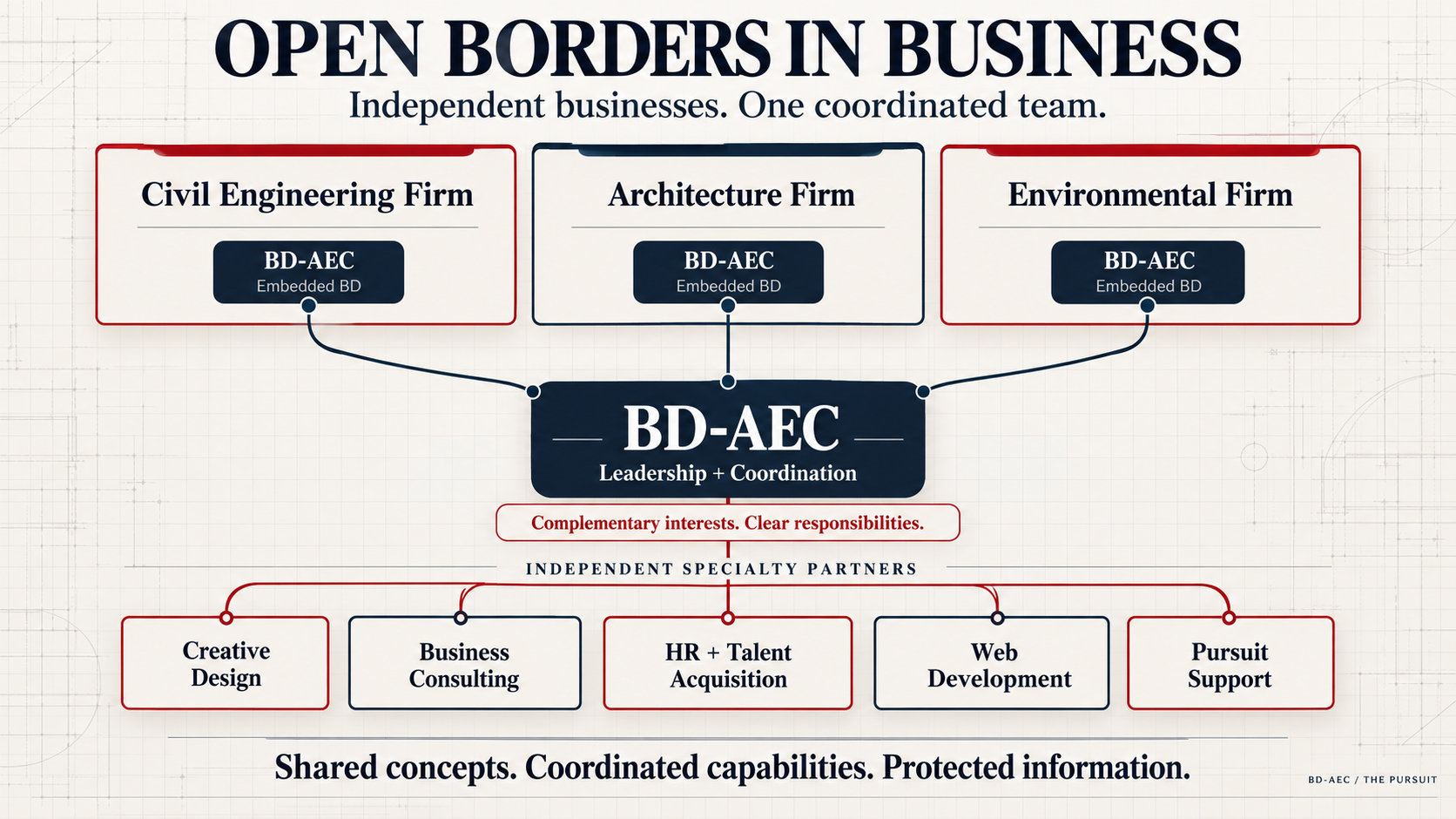
I have approached BD-AEC as the primary business around which specialty partners contribute their expertise.
We present as a unified team. The participating businesses remain standalone entities.
That allows us to build an offering around the work rather than assume that every capability must first become an internal department. It also means we have to do the work of integration: sharing the appropriate context, establishing priorities, coordinating contributions, and keeping the client’s objectives in view.
The value comes from how the capabilities are assembled and directed.
A business can be defined by the capabilities it coordinates as well as the people it employs.
The Boundary Opens in Both Directions
This becomes particularly important when BD-AEC describes its offering as an embedded business development department.
We bring a team around our own business. We also work inside the business development function of a client firm.
For client firms, I use an email address with their domain. I have a client-firm business card identifying me as their Director of Business Development. I represent them at events, conferences, and meetings.
Those details reflect how the engagement operates.
I am carrying the client firm’s message into the market, developing its relationships, discussing its capabilities, and helping pursue its opportunities. The working identity needs to support that responsibility.
A prospective client should be able to reach the person responsible for business development through the firm they are considering. A teaming partner needs to understand which company I am representing. The client’s technical leaders need someone connected to their priorities and familiar with their business.
That is what makes the arrangement embedded.
BD-AEC becomes part of how the firm develops business, with a broader team supporting the work.
The Email Address Is the Easy Part
An email account and a business card help establish the working relationship. They do not create the understanding required to represent a firm well.
That requires learning the business.
What work does the firm want more of? Which projects demonstrate its strengths? What can the team deliver? Which relationships matter? How do the principals make decisions? Where is the firm competitive, and where does it need additional support?
The answers influence what happens in a client meeting, how an opportunity is evaluated, and what the firm should say in a proposal.
Representation also requires access to the right conversations inside the organization. A business development director needs to understand when priorities change, when capacity tightens, when a project reveals a new capability, or when a client relationship needs attention.
The arrangement works when the client and the embedded team share enough context to make useful decisions together.
That is a deeper form of integration than adding a name to an organization chart.
Representing Complementary Firms Creates Another Advantage
My work is not limited to representing one firm at a time.
I can represent multiple firms whose capabilities and teaming interests intersect. I do not represent firms competing against one another. These relationships are built around complementary interests and opportunities to work together.
That can create a useful perspective when assembling a pursuit team.
Knowing a firm through its website or qualifications package is different from understanding how it operates. Working inside the business helps me understand its capabilities, leadership priorities, delivery capacity, and the work it wants to pursue.
When I have that understanding of several complementary firms, I can make more informed judgments about where their interests align.
A potential teaming relationship becomes more than a match between service lists. We can consider whether the firms’ expectations, approaches, and capacity support the work they would undertake together.
That knowledge can help identify combinations worth exploring, recognize gaps earlier, and prepare more useful conversations between the firms.
Working Inside Several Businesses Sharpens the Advice
The learning extends beyond teaming.
My involvement with client firms includes executive discussions, financial conversations, strategic planning, hiring and recruiting, and high-level business decisions. Those conversations reveal how growth choices interact with the realities of running an AEC firm.
A market may appear attractive until leadership examines the staffing it requires. A promising pursuit may place pressure on a project manager who is already carrying too much responsibility. A hiring decision may change the firm’s ability to develop a service line. A financial discussion may reveal that the work generating the most activity is not the work leadership wants more of.
Participating in those decisions across multiple businesses helps hone our advice.
We encounter different approaches to similar problems. We see where an assumption holds up and where it needs to change. We learn which questions deserve attention before recommending another pursuit, another hire, or another investment in growth.
That broader perspective carries a responsibility to protect each firm’s confidentiality.
I do not share proprietary information or sensitive specifics from one business with another. What I can bring into a conversation are concepts, general lessons, and generic examples that help us examine a problem without exposing another firm’s private circumstances.
Each recommendation still needs to fit the business receiving it. An approach that works for one firm may need to change for another because its people, economics, capacity, and ambitions differ.
The purpose is to carry stronger judgment across organizational boundaries while preserving the confidentiality, trust, and integrity of every client relationship.
We share concepts and learning. We protect each firm’s confidential information.
Transparency Strengthens the Model
On BD-AEC’s website, I make the composition of our team visible.
Our About page identifies the people working within BD-AEC and the affiliations of strategic partners who contribute specialized capabilities. The client can see how the broader team is assembled.
I think that transparency is part of the offering’s credibility.
Clients deserve to understand who is doing the work, what expertise they bring, and how their contribution fits into the engagement. A partner’s independent identity can help explain why that business belongs on the team.
The same principle applies to AEC pursuits. A proposal should make the proposed firms and their responsibilities understandable. The team gains strength when its composition has a clear purpose.
A unified presentation can preserve those distinctions.
One coordinated client experience can involve several independent businesses.
Integration Creates an Obligation to Coordinate
Bringing several businesses into an offering creates work for the organization leading it.
Someone has to carry the relevant client context across the team. Someone needs to explain why a positioning decision matters to the website, how a market priority should influence outreach, and what a pursuit requires from the technical and creative contributors.
The client should receive the benefit of specialized expertise without having to reconstruct the engagement every time another capability becomes involved.
That requires clear ownership.
Who is directing the effort? Who is responsible for each contribution? Which decisions require the client’s involvement? How will the team resolve conflicting priorities? Who keeps the next action moving?
For BD-AEC, coordination is part of what we provide. The broader team supports the client’s business development function through a shared understanding of the work.
The public-project teaming experience is a useful reminder here. Adding another specialist improves the team when that contribution has a defined role and connects to the rest of the assignment.
Decide What the Business Needs to Own
Specialty partners bring experience developed through operating their own businesses. Their professional disciplines, working methods, and perspectives can contribute useful judgment to the team.
A creative partner may recognize a positioning problem that a business development professional sees differently. An HR specialist may identify a people issue affecting a growth plan. A web specialist may show that the firm’s digital presence is failing to support the story being told in meetings.
Those perspectives become valuable when the team connects them to the client’s objectives.
Internal capability remains valuable, too. Some functions deserve permanent investment inside the firm. Their importance, frequency, or connection to daily operations may justify building and maintaining them directly.
Other capabilities may be better accessed through a committed partner relationship. The right decision depends on the firm’s scale, needs, resources, and direction.
Leadership should begin with the capability it needs rather than assume that every need must produce a new employee or department.
That is also the question behind BD-AEC’s embedded model. An AEC firm needs consistent business development capacity. It can decide which parts to build internally and which parts to access through a team already doing the work.
What matters is whether the resulting function has the understanding, ownership, and resources to serve the business.
Build the Team Around the Work
Open borders in business is a theory I continue to exercise through BD-AEC’s work.
AEC teaming has shown me how independent firms can contribute to a unified pursuit. Our specialty partner relationships apply that thinking to BD-AEC’s offering. Our embedded engagements take it into the client firm’s business development function.
Representing complementary firms also gives us opportunities to examine business decisions from several perspectives and sharpen the advice we bring to each client.
Across those relationships, the practical challenge is similar: make the responsibilities clear, share the appropriate context, protect confidential information, and give the team a way to act together.
The company remains a distinct business. The team serving its objectives can extend beyond its payroll.
That creates room to ask a more useful question about growth:
What capabilities does this business need—and what is the best way to bring them together?
To discuss the business development team your firm needs, start a conversation with BD-AEC.
About this story
Written byScott MannFounder + Lead Business Development Director, BD-AEC
- Issued
- November 6, 2026
- Corrections
- Spotted an error? Tell us.