The Conference Starts Before You Arrive
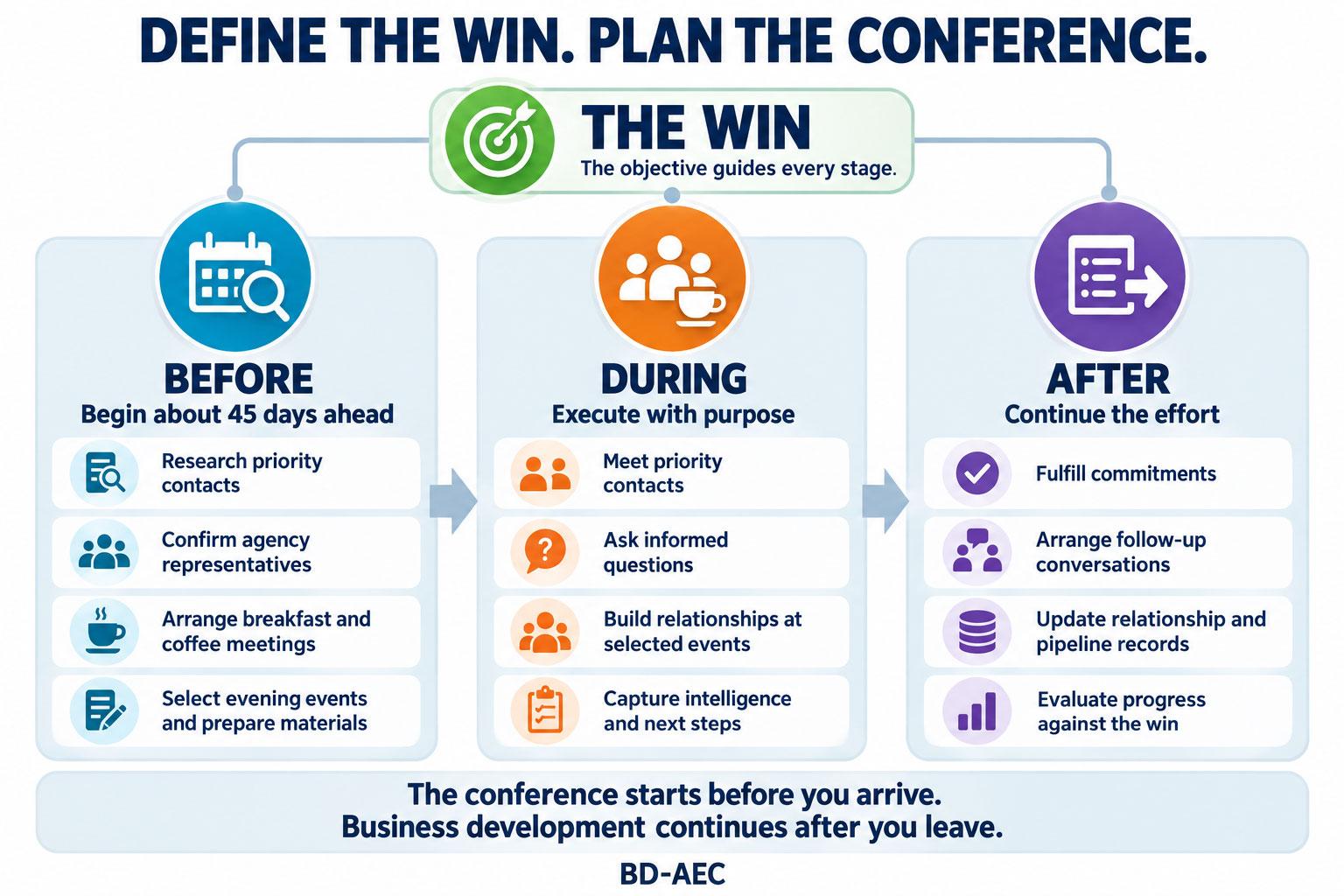
An important AEC conference deserves a business development strategy that begins weeks before the event and continues after it ends. Define the win first, then plan the preparation, execution, and follow-up around it.
 By Scott Mann, Founder + Lead Business Development Director
In this story 15 sections
An important AEC conference deserves a business development strategy that begins weeks before the event and continues after it ends. Define the win first, then plan the preparation, execution, and follow-up around it.
When I plan to attend an important conference, my preparation begins about 45 days before the event. By the time I arrive, I want to understand why I’m there, which relationships deserve attention, what I need to learn, and what should happen afterward.
I will be attending the Society of American Military Engineers’ Federal Small Business Conference in Charlotte, North Carolina, November 4–6, 2026. I have already begun developing our approach for the periods before, during, and after the conference. SAME’s official event announcement
For me, those are connected parts of one business development effort. Preparation should improve the conversations we have during the event. Those conversations should produce information and next steps that shape the follow-up. What we learn afterward should influence future relationship development and pursuit decisions.
The starting point is understanding “the win.” Before committing time, travel, and resources, I want to know what would make the conference worthwhile for the firms I represent. That answer gives the rest of the effort direction.
Define the Win Before You Build the Schedule
“We should attend” is a decision about presence. It still leaves the business development objective unresolved.
A firm might attend a conference to develop relationships with prospective clients, identify teaming partners, explore a market, reconnect with existing contacts, or understand where its capabilities fit into an owner’s future needs. Several of those objectives may apply, but they should be specific enough to influence how the team spends its time.
Suppose an engineering firm wants to become a subconsultant to prime firms pursuing a particular category of federal work. Its conference strategy should reflect that objective. Which primes are relevant? What capabilities might they need? What experience can the engineering firm demonstrate? What would a useful next step look like after an introductory conversation?
Another firm may be evaluating whether a market deserves further investment. Its win could be a clearer understanding of buyer needs, procurement timing, competitive conditions, and gaps in its qualifications. That intelligence may be valuable even if the conference produces no immediate opportunity.
A conference can serve more than one purpose, but priorities matter. If everything counts as a win, it becomes difficult to decide what deserves preparation or evaluate what the event accomplished.
Define the win clearly enough that it changes what you do before, during, and after the conference.
Why I Begin About 45 Days Before the Event
The 45-day window gives me time to turn an intention into a plan. It allows room for research, outreach, coordination, and preparation while the rest of the business development work continues.
I want to understand which organizations are relevant, who may be attending, what the available program tells us, and where our existing relationships might create useful introductions. Some information will become available closer to the event, so the plan needs to evolve. Beginning early gives us a foundation to improve as we learn more.
It also gives us time to contact people before their schedules fill. A thoughtful message explaining why a conversation would be useful is easier to prepare when we have researched the organization and considered the connection. We may be able to arrange a meeting, reconnect with someone we already know, or establish enough context to make an introduction at the conference more productive.
Materials need attention, too. If a particular project demonstrates the experience we want to discuss, we should have a usable description. If a capabilities statement needs updating, we should do that before departure. If technical staff will participate, they should understand the objectives and the conversations where their expertise will be most helpful.
Preparation gives us more useful choices when we arrive. It also reduces the amount of valuable conference time spent figuring out what we should have organized beforehand.
Identify the People You Would Otherwise Struggle to Reach
One of the most useful conference-planning questions is straightforward: Who will be there that would normally be difficult for us to access?
A conference may bring together people who would otherwise require separate trips, several introductions, or months of outreach to meet. That could include a senior leader at a prospective teaming partner, a program representative from an agency, an existing client based in another region, or someone whose responsibilities make an ordinary introductory meeting difficult to arrange.
Their presence deserves attention before the event. Who are they? Why would a conversation matter? What do we need to understand about their organization? Can someone we know make an introduction? Is there a scheduled session, reception, or other appropriate setting where we might meet?
We should also be realistic about access. Appearing on a program or attendee list does not mean someone has agreed to meet with us. A focused request, a relevant reason for the conversation, and flexibility about timing can help us make better use of the opportunity.
The objective is to identify where being in the same place creates a useful opening and prepare to use it respectfully.
Research the Organizations Behind the Names
An attendee or exhibitor list can be a starting point, but a list of names doesn’t explain why we should meet someone. The research needs to connect an organization’s work with the capabilities and objectives of the firm we represent.
For a prospective teaming partner, I want to understand what they pursue, where they work, and how our firm might contribute. For an owner or agency, I want to understand the relevant programs, needs, and buying environment. For an existing relationship, I want to know what has changed since our last meaningful conversation.
The depth of research should be proportional to the importance of the relationship. We don’t need an elaborate dossier on everyone at the event. We do need enough understanding to ask informed questions and avoid using valuable meeting time to learn facts we could have found beforehand.
This is where market intelligence becomes practical. Research helps us decide whom to prioritize, what to discuss, and which assumptions need to be tested in conversation.
Understand Which Government Representatives You Can Meet
For a conference connected to government work, I want to know which agencies will be represented and which people we may have an opportunity to meet. That includes contracting officers, small business representatives, program personnel, and technical leaders where their participation is confirmed.
Those roles are different, and the preparation should reflect that. A contracting officer may be the appropriate person for questions about acquisition procedures or where procurement information is published. A small business representative may help us understand how to introduce the firm to the agency. Program and technical personnel may provide context about the work their organizations perform and the capabilities relevant to it.
Before the event, we should review the published program and available meeting arrangements. Which representatives are confirmed? Are appointments required? Are there designated networking or matchmaking opportunities? What questions would be useful and appropriate for each person?
I want to arrive with more than a general request to “tell us about your opportunities.” We should be able to explain our capabilities briefly, demonstrate that we have done some homework, and ask questions that help us understand how to engage with the agency.
We should also recognize that representatives may be limited in what they can discuss, particularly about active procurements. A conference conversation should help us understand the appropriate process and next step. It should not be treated as a commitment to future work.
Build Meetings Around the Conference Day
The formal program is only part of the schedule. Breakfast before the conference day begins, coffee between sessions, and drinks after the day’s program can create useful opportunities for focused conversations.
I want to consider those possibilities before everyone arrives. A breakfast meeting can provide time with a prospective partner before the exhibit floor and sessions begin competing for attention. A coffee meetup can turn a brief introduction into a more useful discussion. An invitation to meet for drinks afterward can give an existing relationship room to develop beyond a hurried conversation in an aisle.
The format should fit the person and the purpose. Some people will prefer a short coffee meeting. Others may have time for breakfast or an evening conversation. A useful invitation explains why we would like to meet, suggests a manageable amount of time, and makes it easy to respond.
Specific arrangements help. Agreeing on a time and location is more reliable than saying, “We should catch up while we’re there.” We should also account for travel between venues and leave enough flexibility for sessions to run long or schedules to change.
These meetings belong in the business development plan because they require preparation and follow-through just as a formal appointment does.
Choose Evening Events With Relationship Priorities in Mind
Evening events deserve the same consideration as the daytime program. Who is hosting receptions or gatherings? Which organizations are likely to participate? Where might we reconnect with important contacts or meet people relevant to our objectives?
The best choice may be a smaller gathering hosted by a prospective teaming partner, a reception where existing relationships can make introductions, or an event connected to a market we want to understand. A crowded room can provide plenty of activity without necessarily providing the access or conversation we need.
Before committing the evening schedule, I want to understand which events are open, which require registration or an invitation, and where there is a credible reason to attend. Invitations and attendance should be confirmed where possible rather than assumed.
Coordination matters when several people from the firm are attending. The team may benefit from covering different events, while an important relationship may justify attending together. Those decisions should follow the priorities established before the conference.
A reception can be a productive setting for relationship building. Its value depends on whom we meet, what we learn, and whether there is a reason to continue the conversation afterward.
Prepare the Story and the Evidence
Once we know whom we want to reach, we need to consider what will be relevant to them. The firm’s story should connect its capabilities to the work and problems the other organization cares about.
A broad introduction may establish what the firm does. A useful business development conversation usually needs more specificity. Which experience demonstrates our relevance? What role could we perform on a team? What distinguishes our approach? What can we substantiate?
That preparation should extend to the materials supporting the conversation. Capabilities statements, project examples, resumes, and website content should reinforce the same understanding of the firm. We should be able to provide appropriate information without reconstructing it after someone asks.
Technical professionals have an important role here. Their experience can make a conversation more credible and useful, particularly when questions move beyond a general introduction. Preparing them means giving them context about the organization, the objective, and the reason their participation matters.
The goal is to make the firm easy to understand and give the other person a sound reason to continue the conversation.
Execute With Priorities and Room to Adapt
During the conference, the plan should help us make choices. Scheduled meetings, relevant sessions, introductions, and existing relationships all compete for attention. We need enough structure to protect the priorities we established before arrival.
We also need room to respond to what happens. An unexpected introduction may be valuable. A session may reveal information that changes our understanding of a market. A conversation may point us toward an organization we had not considered.
A useful strategy accommodates those developments without allowing every new possibility to displace the original objectives. We should be able to explain why a change deserves our time.
If several people from the firm attend, brief check-ins can help the team compare what it is hearing, identify gaps, and adjust the remaining schedule. Someone may have learned something that changes the questions we should ask in the next meeting. Another person may need help arranging a technical conversation or securing an introduction.
The conference plan should improve as new information comes in.
Listen for What Should Happen Next
Conference conversations should give us more than an opportunity to describe the firm. They should help us understand the other organization’s needs, priorities, and circumstances.
For a potential teaming partner, that may mean learning where they need complementary expertise or how they evaluate prospective subconsultants. For an owner, it may mean understanding a future need or identifying where our assumptions are incomplete. For an existing contact, it may mean learning how their responsibilities or priorities have changed.
The questions should follow the conversation rather than feel like a checklist. But we should be listening for information that helps us decide whether there is a reason to continue and what a useful next step would be.
That next step could be sending a relevant project example, arranging a technical discussion, making an introduction, or reconnecting at a more appropriate time. It should reflect what was discussed and what both parties agreed would be useful.
A good conference conversation gives the follow-up a purpose.
Capture the Context While It Is Fresh
After several days of conversations, details can become difficult to separate. A business card or contact record may tell us whom we met while leaving out the information that made the meeting valuable.
I want the record to preserve the relevant context: what we discussed, what we learned, why the relationship matters, what we offered to provide, and what should happen next. If someone mentioned a future need, we should distinguish between what they confirmed and what we inferred.
Capturing that information during the event makes the follow-up more useful. It also allows the knowledge to move beyond the person who attended. A technical leader, another BD professional, or someone responsible for a pursuit should be able to understand the conversation without depending on memory weeks later.
The process can be simple. Its value comes from preserving the information needed to take the next action.
Plan the Follow-Up Before the Conference Ends
Post-conference follow-up deserves capacity on the calendar. If we return to a full workload with no time assigned to the commitments we made, the effort can lose momentum quickly.
The approach should reflect the conversation. A promised document should be sent promptly. A potential teaming discussion may need a meeting with the right technical people. An exploratory relationship may need further research before we propose another conversation. Some contacts may belong in a longer-term relationship plan rather than an immediate pursuit.
A useful message reminds the recipient of the discussion and delivers something relevant. It might provide the project example they requested, answer a question, or suggest the next step we discussed. The timing should honor our commitments and fit the other person’s circumstances.
Responsibility needs to be clear. Someone should own each next action, know when it is due, and have access to the context required to complete it. That is how conference activity becomes continuing business development.
Evaluate the Conference Against the Win You Defined
After the event, we should return to the objectives established during preparation. Did we develop the relationships we intended to develop? Did we reach people who would otherwise have been difficult to access? Did we learn what we needed to know? Did relevant conversations produce next steps?
Activity measures can help describe what happened, but they need interpretation. A large number of contacts may contain little useful progress. A smaller number of well-qualified conversations may provide a stronger basis for future work.
We should also recognize the time horizon. A relationship developed at a conference may lead to an opportunity months later. That makes it important to track progress without treating every introduction as pipeline or expecting immediate awards from every event.
The evaluation should improve the next decision. We may adjust which events we attend, whom we send, how we prepare, what materials we need, or how much support the effort requires. The conference should leave us with a better understanding of both the market and our own approach.
Put Support Around the Conference Effort
This is one way BD-AEC can support a firm that already has an internal business development professional. The BD leader may know what the conference should accomplish while needing additional capacity for research, outreach, meeting preparation, materials, coordination, or follow-up.
That support can be defined around the event. The internal team brings its knowledge of the firm and its relationships. We work alongside them to help prepare the effort, carry out agreed responsibilities, and continue the actions that come from it.
An important conference requires attention across several weeks. Building the right support around that period can help the firm make better use of the investment it has already decided to make.
The Conference Is Part of a Longer Business Development Effort
As I prepare for SAME’s Small Business Conference in Charlotte, I am thinking about the full effort: whom we should contact before arriving, which breakfast and coffee meetings we should arrange, which evening events deserve attention, and how we will follow through afterward.
The win needs to be understood well before the conference begins. It gives the research direction, helps prioritize the schedule, shapes the conversations, and provides a basis for evaluating what happened.
For an AEC firm, an important conference can be a valuable business development opportunity. Making use of it requires preparation and continued attention after the event. The relationships and intelligence we bring home should influence what we do next.
The conference starts before you arrive, and the business development continues after you leave.
About this story
Written byScott MannFounder + Lead Business Development Director, BD-AEC
- Issued
- October 27, 2026
- Corrections
- Spotted an error? Tell us.